
Enterprise recruiting software in 2026 is undergoing a fundamental transformation, driven by AI advancements, regulatory pressures, and shifting candidate expectations. Organizations that adapt to these changes are seeing measurable gains in speed, cost, and hiring quality.
Summary
- The global recruitment software market is valued at $3.77 billion in 2026 and projected to reach $5.5 billion by 2031, with 87% of companies now using AI in their recruiting processes.
- Agentic AI has replaced simple automation, managing entire multi-step hiring workflows autonomously and cutting time-to-shortlist by 75%.
- Bias, fairness, and compliance have become non-negotiable, with new regulations like NYC Local Law 144 and the EU AI Act reshaping how hiring technology must be governed.
- Skills-based hiring is replacing credential-focused evaluation, with platforms now inferring candidate capabilities from career trajectories rather than relying on keywords and job titles.
- Enterprises are consolidating fragmented point-solution stacks into unified platforms to eliminate data silos and reduce total ownership costs.
- The recruiter role is evolving rather than disappearing, with AI handling volume and speed while humans focus on relationships, negotiation, and complex judgment calls.

If you have spent any time in talent acquisition lately, you have probably noticed that the landscape looks almost nothing like it did just a few years ago. The tools are smarter, the expectations are higher, and the margin for error is thinner than ever.
Enterprise recruiting software in 2026 is not about keeping pace anymore. It is about staying ahead of a field that is moving faster than most HR leaders anticipated. From AI that does far more than parse resumes, to regulatory frameworks that are actively reshaping how hiring decisions get made, the trends unfolding right now are ones that every CHRO, TA leader, and people ops professional needs to understand.
We will break down the most important movements in enterprise recruiting software in 2026, organized by theme, with real data to back them up. Whether you are evaluating a new platform, building a business case for your tech stack, or just trying to make sense of the noise, here is what is actually happening out there.
The Market Itself Is Growing Fast, and Companies Are Buying In
Before diving into individual trends, it helps to understand the scale of what is happening. Enterprise recruiting software is not a niche category anymore. It is a major and expanding market, and the investment levels reflect that. Understanding the broader context helps make sense of why every platform is racing to upgrade its capabilities right now.
Here is what the data says about where the market stands in 2026:
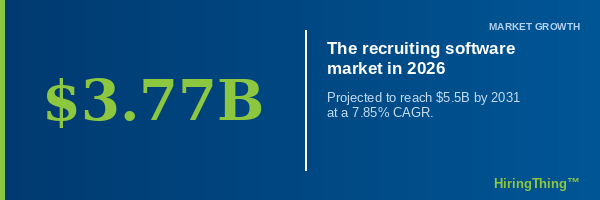
- The global recruitment software market is valued at $3.77 billion in 2026 and is projected to reach $5.5 billion by 2031, growing at a CAGR of 7.85%.
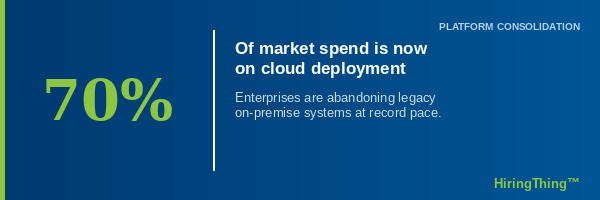
- Cloud deployment already accounts for nearly seven out of every ten dollars spent in this market, and that share is climbing as enterprises abandon legacy on-premise systems.
- 87% of companies are now using AI in some capacity within their recruiting processes as of early 2026, with 99% of Fortune 500 firms reporting integration.
- Recruiting is the single most common area where AI is being applied across HR functions, accounting for 27% of all AI use in HR among organizations that have adopted these tools.
- 60% of extra-large organizations have implemented AI in their HR functions, compared to 33% of small businesses and 35% of mid-sized companies, showing that the enterprise advantage is compounding.
- 93% of recruiters plan to increase their AI usage in 2026.
The gap between enterprises and everyone else is widening. The investment is accelerating. And the competitive pressure to modernize is now structural, not optional.
Agentic AI Is Replacing Simple Automation
For the past several years, "AI in recruiting" largely meant resume parsing and keyword matching. That era is effectively over. The defining shift in enterprise recruiting software in 2026 is the rise of agentic AI: systems that do not just complete individual tasks, but that manage entire multi-step workflows autonomously, adapting their approach based on what is working.
The difference between traditional automation and agentic AI is worth spelling out. Traditional automation follows rules. If a candidate answers a knockout question a certain way, route them accordingly. Agentic AI works from goals. Give it the objective of identifying and engaging the 50 best candidates for a role, and it figures out how to search across databases, evaluate fit, sequence personalized outreach, handle responses, and surface the strongest profiles, all without a recruiter directing each step. As the HiringThing AI Recruiting and Hiring Playbook for 2026 describes it, the question for modern teams is no longer whether AI belongs in hiring, but whether the people responsible for recruiting feel genuinely confident using it well.
The data on agentic AI's reach and impact in 2026:
- 40% of enterprise applications are expected to include task-specific AI agents in 2026, a significant jump from 2025 levels.
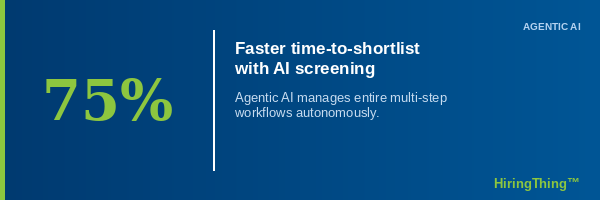
- AI screening cuts time-to-shortlist by 75%, giving enterprise teams a meaningful speed advantage over organizations still relying on manual review.
- 52% plan to add autonomous AI agents to their recruiting teams this year.
- Recruiters save up to 70% of sourcing time once agentic AI is fully implemented.
The practical implication for enterprise TA teams: the question is no longer whether to use AI, but how to build workflows around AI agents while keeping humans where they add the most irreplaceable value, which is relationships, negotiation, and cultural judgment.

AI Bias, Transparency, and Compliance Are Now Non-Negotiable
The efficiency gains of AI in recruiting are real and well-documented. But they come with a parallel conversation that enterprise organizations can no longer defer: bias, fairness, and legal compliance. This is one of the most active and consequential areas in the entire recruiting software space right now, and the regulatory environment is moving fast.
Understanding what candidates and HR leaders actually think about AI fairness is the starting point. As the HiringThing 2026 AI Recruiting and Hiring Playbook makes clear, compliance, ethics, and transparency have evolved from box-checking exercises into genuine competitive advantages that directly influence trust with both candidates and hiring teams.
The data tells a complicated story:
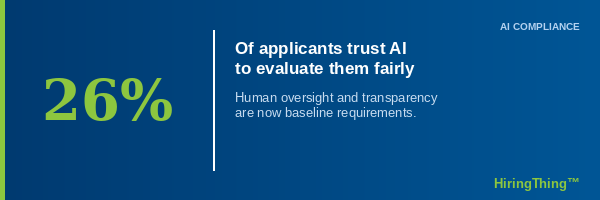
- Only 26% of applicants trust AI to evaluate them fairly, making visible human oversight and clear explanations baseline requirements in 2026 hiring.
- 40% of HR leaders cite bias and fairness as their top concern about AI hiring tools.
- McKinsey's research shows that 29% of AI models in hiring demonstrate gender bias without active mitigation.
- Deloitte's 2026 data shows that only 22% of recruiting organizations are in full compliance with ethical AI standards.
- Only 29% of organizations are currently auditing their AI hiring tools, representing a material gap between regulatory expectation and actual practice.
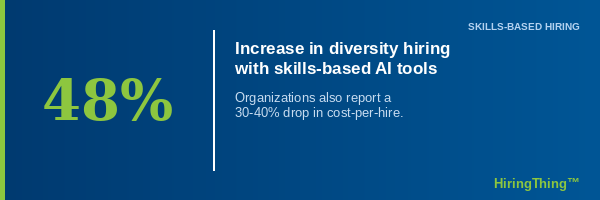
- Organizations aligning AI recruiting tools with clear, well-governed objectives report up to a 48% increase in diversity hiring effectiveness and a 30 to 40% drop in cost-per-hire.
The regulatory landscape is responding rapidly. Key compliance milestones in 2026 include:
- New York City's Local Law 144 continues to require annual bias audits and candidate notifications before using automated employment decision tools.
- Illinois law effective in 2026 specifically requires notifying candidates when AI-powered video interviews are used.
- EU AI Act obligations for general-purpose AI began in August 2026, raising compliance expectations for any employer or vendor deploying hiring technology in Europe.
The companies getting this right are not just avoiding liability. They are hiring better.
Skills-Based Hiring Is Reshaping How Enterprises Evaluate Candidates
One of the most substantive philosophical shifts happening inside enterprise recruiting in 2026 is the move away from credentials and toward demonstrated competency. Skills-based hiring, which evaluates candidates on what they can actually do rather than on the degrees they hold or the job titles they have carried, is no longer a progressive experiment. It is becoming standard practice among leading enterprises, and the software is finally built to support it at scale.
As HiringThing's analysis of how AI is shaping recruitment tools notes, platforms like HiringThing now help hiring teams move faster and reduce bias by focusing on skills and relevant data instead of manual review alone. That is precisely the direction the entire enterprise market is heading.
Here is what is driving the skills-based shift:
- The emphasis on skills in workforce planning is actively changing how organizations hire, with AI playing a central role in inferring capabilities from career trajectories and adjacent experience, even when candidates do not use the exact language a job description calls for.
- Eightfold AI's skills taxonomy and inference engine identifies candidate potential beyond what is explicitly stated on a resume, surfacing non-obvious matches and internal mobility opportunities at enterprise scale.
- Skills-based platforms are gaining particular traction for DEI initiatives, where skills-based evaluation removes demographic proxies from the early stages of candidate assessment.
- As baby boomer retirements accelerate and AI agents absorb certain entry-level functions, platforms that map existing employee capabilities against open roles are reducing external hiring costs and improving retention simultaneously.
- Predictive modeling for future workforce needs, based on skills gap analysis and historical hiring data, is identified as a fast-growing capability in enterprise recruiting platforms.
- SeekOut's talent intelligence platform aggregates data across millions of professional profiles and internal HR systems to help enterprises understand where skills exist across both internal and external talent pools simultaneously.
The internal mobility dimension of this trend is significant and often underappreciated. By mapping existing employee capabilities against open roles, skills-based platforms help organizations promote from within more effectively, and that matters a great deal when external hiring is expensive and retention pressure is high.
Platform Consolidation Is Winning Over the Point-Solution Stack
Ask any enterprise TA leader what their biggest operational headache is, and there is a good chance it involves data fragmentation. Separate tools for sourcing, screening, scheduling, CRM, analytics, and onboarding, each with their own logins and their own data structures, create exactly the kind of friction that slows hiring down and makes reporting a nightmare. The 2026 trend in enterprise recruiting software is decisive: organizations are consolidating.
The logic behind consolidation is straightforward. Integrated platforms cut ownership costs, eliminate data silos, and provide the single worker record that connects recruiting to payroll, performance management, and onboarding.
The key data points:
- Enterprises are actively decommissioning on-premise ATS platforms in favor of unified SaaS suites.
- Enterprise recruiting software now ranges from $5,000 to $30,000 annually for mid-market platforms and $100,000 or more per year for full enterprise talent acquisition suites.
Vendors are also pooling anonymized hiring data to train matching algorithms that improve fill-rate accuracy over time. The result is a virtuous cycle: more users feed better models, which produce better matches, which attract more enterprise buyers.

Data-Driven Recruiting and Talent Intelligence Are Becoming Core Infrastructure
Gut instinct has never been a reliable strategy for building great teams, but until recently, it was often all that was available at speed. In 2026, the infrastructure for truly data-driven enterprise recruiting is finally mature, and the organizations that are using it well are seeing measurable results that compound over time.
As HiringThing's guide to AI in tough economic times puts it, leaders should track a small set of outcomes that tell the truth: time to slate, time to offer, offer acceptance, quality of hire, recruiter capacity, adverse impact rates, and candidate satisfaction. That kind of measurement is now possible in ways it simply was not before.
The ROI case for data-driven recruiting is compelling:
- Companies save $4,500 per hire by using AI screening compared to manual approaches.
- AI-driven automation drives a 25% reduction in overall recruiting costs.
- Oracle's AI recruiting hub reduces global hiring time by 33%.
- Workday's AI skills inference engine speeds candidate matching by 40%.
- Organizations using AI for recruitment achieve 25% faster completion of critical role positions.
- AI-driven hiring tools enable recruiters to increase productivity by as much as 40%.
- Enhanced productivity, cost savings, and improved decision-making are the top three metrics organizations are tracking when measuring ROI of AI investments.
Talent intelligence platforms sit at the top of this stack. These tools combine internal workforce data, external labor market insights, and predictive analytics to give organizations a real-time view of their talent ecosystem. The goal is to move from reactive requisition-filling to proactive pipeline-building grounded in actual market data.
Mobile-First, Candidate-Centric Design Is No Longer Optional
Enterprise recruiting software has historically been built for recruiters and hiring managers. The candidate experience was an afterthought. That calculus has shifted dramatically, and organizations that are not paying attention to it are watching qualified candidates drop off mid-funnel. Today's job seekers arrive more informed, more prepared, and more impatient than any previous cohort.
As HiringThing's guide to positively managing applicants' concerns about AI notes, the best recruiting experiences spell out what the process will look like so candidates know what they are in for, and they make the human presence visible throughout. That is both a design principle and a trust strategy.
The candidate experience data in 2026 makes the stakes clear:
- Mobile-first recruitment solutions are a key differentiating trend in 2026, with the most competitive enterprise platforms offering fully functional mobile experiences for both candidates and hiring teams.
- Omnichannel communication is a core differentiator, with leading platforms supporting consistent interaction across email, SMS, WhatsApp, and app-based channels.
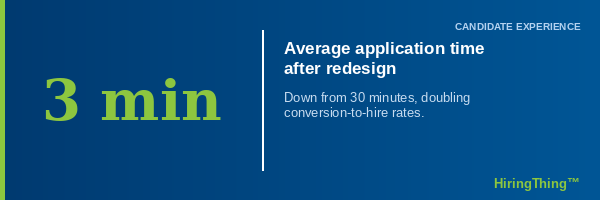
- One company, for example, reduced average application time from 30 minutes to 3 minutes and increased conversion to hire from 1.7% to 3.5% through friction-reducing workflow redesign.
- Generative AI drafts outreach emails 80% faster than manual writing, enabling more personalized candidate communication at scale.
- AI agents given access to full candidate history achieve 30 to 40% higher candidate response rates.
- Staffing agencies using AI tools report a 23% higher placement rate alongside lower costs.
The broader picture is one where the candidate journey is finally receiving the same engineering attention as the recruiter workflow. That is a meaningful cultural shift inside the enterprise software category, and the platforms winning enterprise deals in 2026 are the ones that have internalized it.
The Human Element Is Staying, but the Role Is Changing
No overview of enterprise recruiting software trends in 2026 is complete without acknowledging the anxiety that runs through the talent acquisition profession right now. With AI handling screening, scheduling, sourcing, and outreach, it is reasonable for recruiters to wonder what their role becomes. The data is clear on this, and it is not the answer many feared.
As the HiringThing 2026 AI Recruiting Playbook articulates directly: automation should create leverage without removing control, and intelligence should support people, not replace them. That belief is increasingly backed by real-world evidence.
Here is what the research shows about how the recruiter role is evolving:
- 67% of talent acquisition professionals now use AI somewhere in their hiring workflow, up from 35% just two years ago.
- 26% of HR professionals who use AI do so weekly, 20% daily, and 9% multiple times per day, reflecting deep integration into daily workflows rather than experimental use.
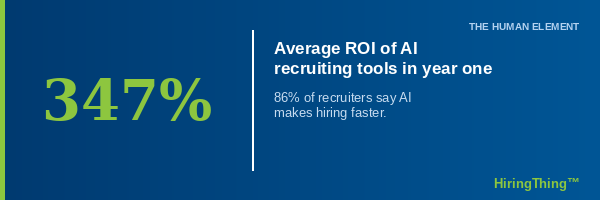
- 86.1% of recruiters say AI makes the hiring process faster, and 89% of HR professionals recognize AI for its ability to save time or increase efficiency.
- AI recruiting tools deliver an average ROI of 347% within the first year for enterprise implementations.
- 40% resistance to AI from hiring managers means change management remains a critical success factor in enterprise deployments.
- Even as AI interviewing with synthetic voices becomes more common at the top of the funnel, the irreplaceable human element in executive recruiting remains essential.
- Jobseekers using algorithmic resume assistance were hired 8% more often, suggesting that well-used AI can benefit both sides of the market.
What AI is doing is redistributing where human time goes. The most successful enterprise recruiting teams in 2026 are the ones that have thought carefully about this division of labor. AI handles volume, consistency, speed, and data. Humans handle complexity, trust, and the judgment calls that algorithms are not equipped to make responsibly.
What This Means for Enterprise TA Leaders
The through-line across every trend above is the same: the infrastructure for smarter, faster, and fairer enterprise hiring exists today, and the organizations investing in it are pulling ahead. The recruitment software market is growing at 7.85% annually for a reason. This is not speculative investment. The ROI is measurable, the use cases are proven, and the competitive pressure is real.
For enterprise TA leaders evaluating their tech stack in 2026, the questions worth asking are concrete ones:
- Does your current platform support agentic AI workflows, or is it running on rigid rule-based automation that requires constant manual intervention?
- Can you demonstrate to legal and compliance teams that your AI tools have been audited for bias and are meeting the requirements of NYC Local Law 144, Illinois 2026 law, or the EU AI Act?
- Does your stack give you skills-based matching and internal mobility insights, or are you still matching on job titles and keywords?
- Is your candidate experience mobile-native and omnichannel, or are candidates abandoning applications on their phones?
- Are your recruiters spending their time on relationships and strategic judgment, or on administrative tasks that software should be handling?
The answers to those questions will tell you a great deal about where you are headed. If you are looking at building or refining a modern hiring platform, HiringThing's enterprise ATS and white-label solutions are designed precisely for this moment, combining AI-assisted screening, open API integrations, and a candidate-first approach that reflects the trends playing out across the market right now. You can dig deeper into the strategic questions every TA leader should be asking over on the HiringThing Blog.
The tools are better than they have ever been. The question is whether organizations are willing to use them well.

About HiringThing
HiringThing is a modern recruiting and HR workflow platform as a service that creates seamless HR experiences. Our white label solutions and open API enable technology and service providers to offer talent software to their clients. Approachable and adaptable, the HiringThing HR platform empowers anyone, anywhere to strengthen their team.

.jpg?width=45&name=1621426681866%20(1).jpg)