.jpg?width=45&name=1621426681866%20(1).jpg)

Recruiting is one of the biggest pain points your HR clients face, and the right applicant tracking system can change that in a hurry. Here's what a private label ATS actually does for the businesses you serve.
Summary
- Saves time and money by automating hiring tasks, shortening time-to-fill, and reducing the steep cost of bad hires and high turnover
- Increases applicant traffic through multi-board job distribution, social posting tools, and built-in referral programs that widen the candidate pool
- Improves candidate experience with streamlined, mobile-friendly applications that keep qualified people engaged instead of sending them elsewhere
- Strengthens employer brand and retention by creating positive hiring touchpoints that build trust, reduce early turnover, and turn new hires into long-term employees
Let's be honest. Most writing about HR technology reads like the instruction manual for a dishwasher nobody wanted. Bland, jargon-stuffed, and about as inspiring as a mandatory compliance training. We're not doing that here.
If you're running an HRIS, HCM, HRMS, PEO, or ASO and you're not offering your clients a solid applicant tracking system (ATS), you're leaving real value on the table. And if you're not private labeling that ATS? You might be working a lot harder than you need to.
HiringThing has spent years building private label ATS solutions for exactly this kind of HR company, and the benefits for your clients are hard to argue with. Here's a straightforward look at five of them.

1. An ATS Saves Real Time and Real Money
Recruiting is expensive. Not in a vague, hand-wavy kind of way. In a keep-you-up-at-night, where-did-the-budget-go kind of way.
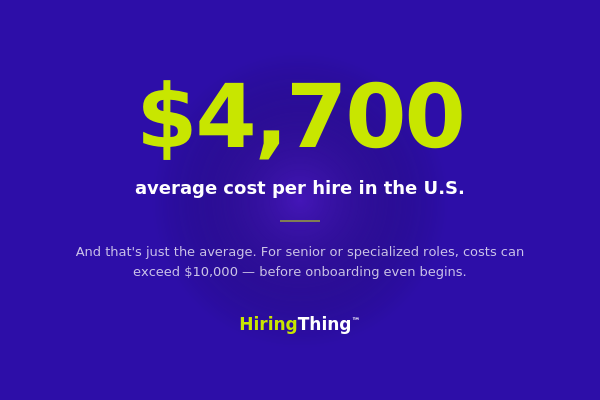
The average cost per hire in the United States now sits around $4,700. For specialized or senior roles, that number can clear $10,000 without much effort. On top of that, every day a position stays vacant costs a business roughly $98 in lost productivity, and the average role takes 40 or more days to fill.
Multiply that across multiple open positions and you start to see the real scope of the problem.
The cost of replacing an employee ranges anywhere from 50% to 200% of their annual salary, depending on the role. For a mid-level employee earning $60,000, that's a potential $30,000 to $120,000 hit every time someone walks out the door. Businesses that hire well and retain people keep more money in their pockets. It really is that simple.
A good ATS helps your clients automate repetitive hiring tasks, move candidates through the pipeline faster, and fill roles before the best people accept an offer from someone else. Think of it as giving your clients the right tools before they head into a competitive job market. Sure, you can try to make do without them. But why would you?
Companies that use an ATS consistently report saving up to 20% of their time on the hiring process. That's time your clients can redirect toward actually running their businesses instead of drowning in résumés.
2. An ATS Brings More Candidates Through the Door
You can't make great hires from an empty pipeline. And right now, a lot of employers are struggling with exactly that.
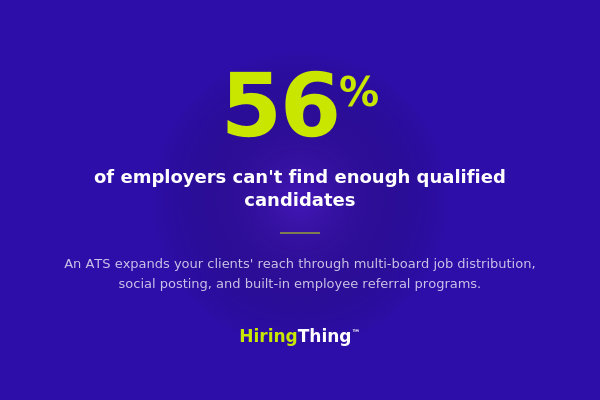
A 2024 hiring challenges report found that 56% of employers say "not enough qualified candidates" is their single biggest recruitment headache. Small and mid-sized businesses feel this the most. When a key role goes unfilled, it affects productivity, morale, and the bottom line all at once.
A well-integrated ATS helps your clients widen their talent pool by distributing job listings across a robust network of job boards simultaneously, enabling social media posting without needing a dedicated social team, and building out referral programs that tap the most reliable source of quality candidates: the people already on the payroll.
HiringThing's blog breaks down specific strategies for increasing applicant traffic that you can share directly with the clients you serve. More visibility means a bigger and better candidate pool, which means better hires. The math is pretty straightforward.
3. An ATS Gives Candidates a Better Experience
Here's something a lot of companies still get wrong: candidates aren't just applicants. They're potential customers, potential brand advocates, and real people with options.
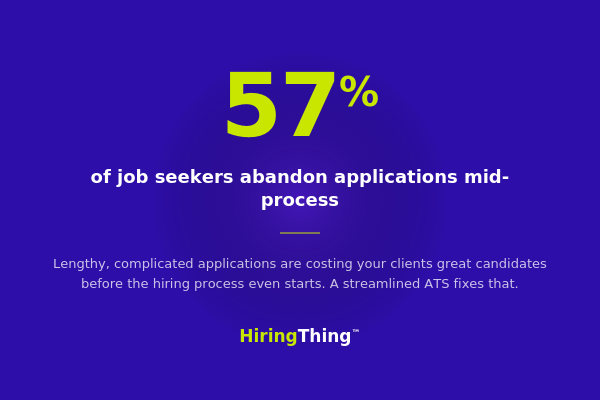
A 2025 report found that 57% of job seekers have abandoned an application mid-process because it was too complicated or too long. That means more than half of interested candidates are walking away before your clients ever get to evaluate them. That's not a pipeline problem. That's a process problem.
Candidates also care deeply about responsiveness. A 2025 candidate experience report found that 66% of candidates said a positive hiring experience significantly influenced their decision to accept an offer, while 26% declined offers outright because of poor communication or unclear expectations.
A competitive ATS makes it easier for candidates to apply quickly, on any device, without jumping through unnecessary hoops. Features like simplified application forms, mobile-friendly career pages, text-to-apply options, and proactive communication keep candidates engaged instead of frustrated. When the experience is good from the start, acceptance rates go up and your clients' reputations get stronger with every hire.
4. An ATS Builds a Stronger Employer Brand
A company's reputation as an employer is shaped long before anyone gets a job offer. It starts the moment a candidate reads the job listing.
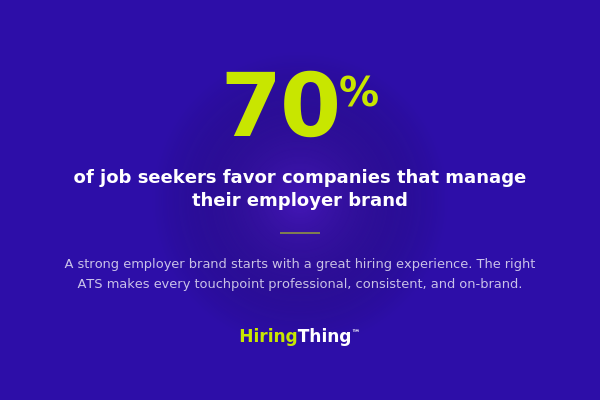
Recent data shows that 70% of job seekers are more likely to apply to a company that actively manages its employer presence online. A strong employer brand reduces turnover and attracts higher-quality applicants. A weak one, or worse, a reputation for a frustrating hiring process, actively drives people away.
The data is clear that candidates who have a bad recruiting experience are likely to share it. They leave reviews. They tell their networks. In a tight labor market, that kind of word-of-mouth matters more than most companies realize.
A great ATS gives your clients the tools to make every touchpoint in the hiring process a positive one: well-written job listings, branded career pages that reflect who the company actually is, self-scheduled interview tools that respect candidates' time, and consistent communication that keeps people informed at every step.
HiringThing makes it easy to put your brand front and center on all of that, so your clients look polished and professional to every candidate who comes through the door.
5. An ATS Reduces Employee Turnover
The relationship between an employer and an employee doesn't start on the first day of work. It starts with the job listing.
When candidates have a smooth, respectful, and transparent hiring experience, they show up on day one with a better attitude and a stronger connection to the organization. Recent research found that new employees who had an exceptional candidate experience were more than three times more likely to feel connected to their company's culture and express genuine job satisfaction.
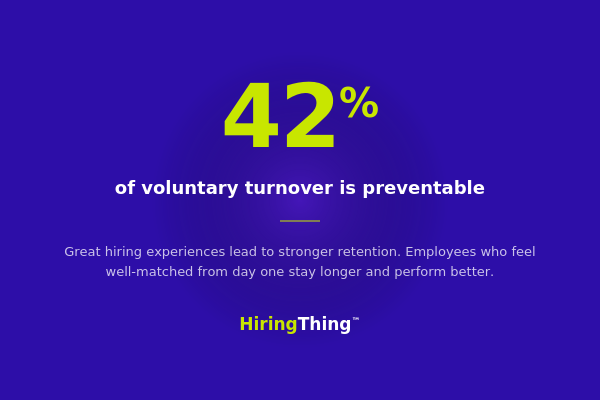
On the flip side, a chaotic or impersonal hiring process breeds early doubts. The numbers back this up: 61% of employees who left their jobs did so within the first 12 months, and 42% of voluntary turnover is considered preventable by the employees themselves. That means the seeds of retention, or the lack of it, get planted early.
A good ATS helps your clients find better matches for open roles, communicate clearly throughout the process, and set realistic expectations so new hires know what they're walking into. Employees who feel well-matched to their role from the start stay longer, perform better, and cost a lot less to retain than to replace.
Learn More About the Economics of ATS Integration
As the leading private label ATS in the HR SaaS space, HiringThing has put together a detailed look at the full economics of ATS integration for HR companies: The Economics of an Integrated Applicant Tracking System: How HR Solutions Can Improve Their Bottom Line.
It covers why ATS integration has become a necessity for today's HR tech stack, how quickly integration can happen, the buy-versus-build question, and exactly how an integrated ATS improves your bottom line. You can find more resources and read more about how it all works on the HiringThing blog.
If you're serious about offering your clients something that genuinely moves the needle on one of their biggest pain points, recruiting is the place to start. And the right ATS is how you get there.
About HiringThing
HiringThing is a modern recruiting and onboarding platform as a service that creates seamless hiring experiences. Our white label applicant tracking system and open API enable technology and service providers to embed hiring capabilities from sourcing to onboarding. Approachable and adaptable, the HiringThing HR platform empowers anyone, anywhere, to hire their dream team.