
Recruitment management involves far more than posting jobs and collecting resumes. It's a complex lifecycle of sourcing, screening, scheduling, and hiring that quickly falls apart without the right system holding it together. This article makes the case that a modern ATS isn't just a nice-to-have tool but the backbone of any effective recruitment strategy, and explores how the right software can transform both the hiring experience and business outcomes.
Summary
- A modern ATS functions as the central nervous system of hiring, connecting job postings, candidate pipelines, and stakeholder communication rather than serving as a simple digital filing cabinet for resumes.
- Disorganized recruitment processes carry real costs through longer time-to-fill metrics, lost candidates who move on to faster employers, and wasted hours on administrative work that software could automate.
- When evaluating recruitment management software, organizations should prioritize ease of use, job board integrations, automated candidate communication, team collaboration features, reporting and analytics, and scalability.
- White label ATS partnerships offer a compelling opportunity for HR tech providers, PEOs, consulting firms, and staffing agencies to add recruiting functionality to their offerings without building a platform from scratch.
- The right ATS doesn't replace human judgment in hiring. It protects that judgment by handling operational logistics so recruiters and hiring managers can focus on genuinely engaging with candidates.

There is a moment that every hiring manager, HR director, and business owner eventually reaches. You have a stack of resumes sitting in an email inbox somewhere, a spreadsheet that made total sense three weeks ago but now looks like a ransom note, and a candidate who has been waiting on a callback since Tuesday. You are not sure who sent the last follow-up email, you are not sure if the role has been posted to the right job boards, and you are starting to wonder if the whole process is working against you rather than for you.
We have all been there. And if you are being honest with yourself, you probably know the answer to the problem sitting right at the center of all that chaos: you do not have the right recruitment management software backing your process.
That is what this article is about. Not a lecture. Not a product brochure. Just a real conversation about why your ATS software is not an optional add-on to your recruitment management strategy. It is the strategy.
What Recruitment Management Actually Means
Before we get into the tools, let us make sure we are talking about the same thing.
Recruitment management is the full lifecycle of finding, attracting, evaluating, and hiring people for your organization. It sounds simple when you say it like that. But in practice, it involves a lot more than posting a job and waiting for resumes to arrive.
The full picture typically includes:
- Job requisition approvals and role definition
- Job board distribution and candidate sourcing
- Resume screening and candidate scoring
- Interview scheduling and feedback collection
- Offer management and background checks
- Compliance documentation and pre-boarding coordination
That is before you even think about reporting to leadership or coordinating between multiple hiring managers who all have different opinions about what a great candidate looks like. In short, it is a lot of moving pieces. And moving pieces without a system to hold them together tend to fall apart right when you need them most.
That is exactly where your applicant tracking system earns its keep. Or where the absence of one starts to cost you.
The ATS Is Not Just a Database
A lot of people think of an ATS as a place where resumes go to live. A digital filing cabinet. Something you log into once a week to check on things. That framing undersells what modern recruitment management software actually does, and it is probably part of why so many organizations are still struggling to hire efficiently.
A well-built ATS is more like the central nervous system of your entire hiring operation. It connects job postings to candidate pipelines, automates the communication that would otherwise fall through the cracks, and gives every stakeholder a single source of truth so no one is working from a different version of the spreadsheet. It tracks where every candidate is in the process at any given moment so nothing and no one gets lost.
When your ATS is working the way it should, your recruiters spend less time on administrative busywork and more time actually talking to candidates. That shift matters more than most organizations realize.
HiringThing's ATS platform is built around exactly this idea: that the software should do the heavy lifting so your people can focus on the human side of hiring.
The Real Cost of a Broken Recruitment Process
Let us talk numbers for a second, because this is where the conversation tends to get real.
A slow, disorganized hiring process does not just feel bad. It costs money. It costs time. And increasingly, it costs you candidates who had other options and took them.
Time-to-fill is one of the most widely watched recruiting metrics in HR, and for good reason. Every day a role stays open is a day your team is either short-staffed or scrambling to cover the gap. When your recruitment management process is held together with email threads and gut instinct, that timeline stretches. Tasks that should take minutes take days. Approvals get stuck because the right person did not get the right notification. Candidates go quiet because no one followed up in time.
The data backs this up. According to our research, job seekers are moving faster than ever through the application process, and they are not waiting around for slow-moving employers to catch up. If your process has friction, your best candidates will find an employer whose process does not.
A strong ATS removes that friction in ways that are easy to see once you are looking for them:
- Automated status updates keep candidates informed so they are never left wondering where they stand
- Organized interview scheduling means no double-bookings and no missed connections
- A smoother front-end application experience reduces the number of candidates who abandon the process halfway through
- Consistent communication across every touchpoint builds a better overall candidate experience
Small improvements in each of those areas compound into meaningfully better hiring outcomes over time.

What to Look For in Recruitment Management Software
Not all ATS platforms are created equal, and this is where a lot of organizations get into trouble. They pick a tool based on price or name recognition without thinking hard enough about whether it actually fits how they hire.
Here are the things that matter most when you are evaluating your options:
- Ease of use for everyone involved. Your ATS needs to work for your recruiters, your hiring managers, and your candidates. If any one of those groups finds it confusing or frustrating, the whole system breaks down.
- Job board integrations. Your roles need to be visible where candidates are actually looking. Good recruitment management software posts to multiple job boards from a single place, which saves time and extends your reach without adding complexity.
- Automated candidate communication. Follow-up emails, status updates, interview confirmations: these touchpoints matter to candidates and they are painful to manage manually at scale.
- Collaboration tools for hiring teams. Hiring decisions are rarely made by one person. Your platform should make it easy for multiple stakeholders to review candidates, share feedback, and move the process forward without anyone losing track of where things stand.
- Reporting and analytics. If you can not measure your recruiting process, you can not improve it. Look for software that surfaces the metrics you care about: time-to-fill, source of hire, offer acceptance rates, and more.
- Scalability. Your hiring needs today are probably not your hiring needs two years from now. The software you choose should be able to grow with you without requiring a full platform switch every time your organization evolves.
The platform checks all of these boxes, and what makes it particularly compelling for organizations building a long-term recruitment management infrastructure is that it is designed to be adaptable from the ground up.
Why White Label Recruitment Software Is a Partnership Opportunity Worth Exploring
Here is something that does not come up often enough in conversations about ATS software: you do not always have to build a recruiting platform to offer one.
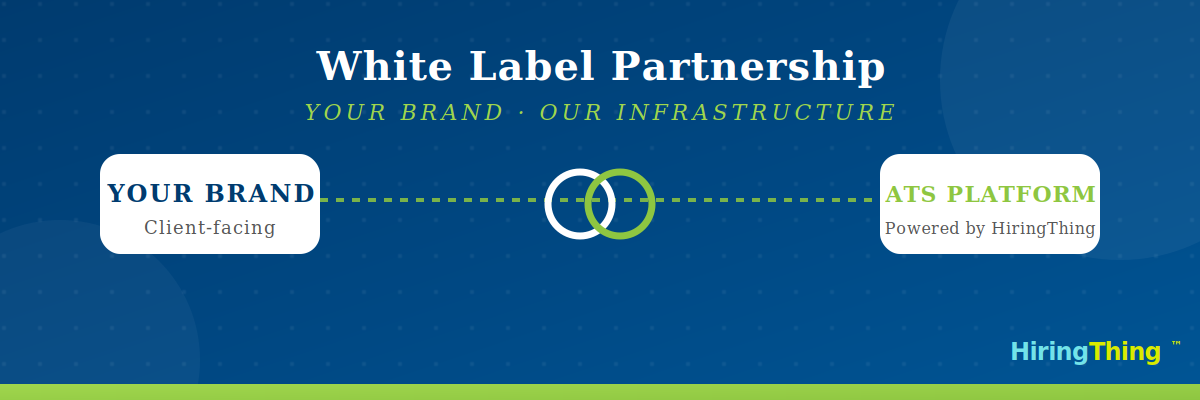
If you serve employers in any capacity, there is a real opportunity to add recruitment management functionality to your existing platform through a white label ATS partnership.
This model works especially well for:
- HR technology providers looking to expand their product offering
- PEOs and ASOs that want to deliver end-to-end workforce management
- HR consulting firms that advise clients on people strategy and systems
- Staffing agencies that need a scalable, brandable hiring infrastructure
- Software companies serving industries with consistent hiring needs
The idea is straightforward. Instead of building applicant tracking software from scratch, which is expensive, time-consuming, and outside most companies' core competency, you partner with a platform that has already done the hard work. You put your brand on it. You deliver a seamless hiring experience to your clients. And you add a meaningful revenue stream to your business without years of development investment.
The white label platform is built specifically for this kind of partnership. Whether you serve small businesses, mid-market employers, or enterprise clients, the platform is flexible enough to fit your use case and your brand. Your clients never know they are using someone else's infrastructure. They just know that the recruiting process works.
For HR consultants and advisors who work closely with employers on their people strategy, this kind of partnership is especially valuable. Your clients are already asking you how to improve their hiring process. A white label ATS gives you a concrete answer, a tool they can use immediately, and a recurring revenue relationship built on solving a problem they genuinely have.
The HiringThing blog has a deep dive on how SaaS partners make money with white label ATS software that is worth reading if you are thinking seriously about this model. It gets into the economics, the positioning, and the practical considerations in a way that is useful for anyone evaluating a partnership.
The Human Side of All This
We want to be clear about something, because it is easy to get lost in the software conversation and forget what is actually at stake.
Hiring is one of the most consequential things a business does. The people you bring on shape your culture, your output, and your ability to serve your customers. When you hire the right person at the right time, it shows. When the process is a mess and the best candidate slips through, that also shows, even if you never find out exactly what you missed.
Good recruitment management software does not replace the human judgment that goes into hiring decisions. It protects that judgment. It makes sure that the right people are being considered, that the process is fair and consistent, that nothing falls through the cracks because someone forgot to send an email or update a spreadsheet. It gives your recruiters and hiring managers the space to actually engage with candidates as people rather than managing logistics.
That is what the right ATS does at its best. It handles the operational weight so your team can focus on the parts of recruiting that only humans can do well.
Getting Started
If your current recruitment management process feels heavier than it should, the fix is almost always simpler than it seems. You do not need a complete organizational overhaul. You need a better system.
Start by mapping out where your current process breaks down. A few honest questions to ask:
- Where do candidates tend to go quiet, and why?
- Where do approvals get stuck in the process?
- Where is your team spending time on tasks that software could handle automatically?
- What does your current reporting tell you, and what does it not tell you?
Once you can see the gaps clearly, the path to fixing them tends to become obvious.
And if you are thinking about adding recruitment management capabilities to a platform you already offer, or if you are advising clients who need a better hiring process, exploring what this platform has built is a good place to start. The partnership model is straightforward, and the problem it solves is one that every employer deals with.
Because here is the thing: recruitment management has always relied on good systems. The organizations that figure that out earlier have a real advantage. The rest catch up eventually, usually after one too many great candidates took a job somewhere else first.
You already know which one you want to be.

About HiringThing
HiringThing is a modern recruiting and HR workflow platform as a service that creates seamless HR experiences. Our white label solutions and open API enable technology and service providers to offer talent software to their clients. Approachable and adaptable, the HiringThing HR platform empowers anyone, anywhere to strengthen their team.