


Payroll platforms already hold the most sensitive employee data in a business, which means they are sitting one small step away from owning hiring too. This piece walks through why that step is shorter than most payroll product teams think, and what the 2026 numbers say about what happens when you take it.
Summary
- Buyers quit asking for more tools: Best of breed procurement dropped to 20.7 percent in the first half of 2026 while the mostly platform approach climbed to 65.9 percent, so the payroll provider who adds hiring is swimming with the current instead of against it.
- Rekeying hire data is the most expensive shortcut in payroll: Roughly 40% of payroll errors trace back to manual data entry, and about one in five payroll cycles still contains an error.
- Two bad paychecks is the breaking point: Around 49% of employees start looking for another job after two payroll errors, which turns a data entry problem into your client's retention problem.
- Onboarding is where the hire either sticks or does not: Close to 38% of employees leave within their first year and two thirds of those exits happen inside six months, while strong onboarding improves new hire retention by 82%.
- The second product is the growth story: Multiproduct platforms are growing about 21% faster than single product peers, and 59% of vertical software companies have already crossed over.
Payroll Software is Where Hiring Belongs
We have been having the same conversation for years now and it starts the same way almost every time. A payroll company gets on a call, tells us their clients keep asking for something to handle job postings and applicants, and then asks whether hiring is really their business.

Let's face it. Payroll already knows an employee's legal name, address, Social Security number, tax withholding, direct deposit details, benefits elections, and pay rate. That is the most sensitive record a business keeps about a person. Compared to holding all of that, tracking someone through a few interview stages before they become an employee is not a leap into a new business. It is finishing the sentence you already started.
Part of my job on the marketing side is figuring out which software providers are the right fit for an embedded hiring product. Payroll has been at the top of that list for a long time, and the market moved in 2026 in a way that makes the case a lot easier to argue.
Buyers Are Not Shopping For More Tools Anymore
Here is the shift that matters most. For a decade the fashionable answer in software procurement was best of breed, meaning you bought the sharpest tool for every job and stitched them together later. That answer is falling out of favor fast.
In a survey of 830 enterprise software decision makers, best of breed procurement fell to 20.7 percent in the first half of 2026, down from 24.3% six months earlier, while the mostly platform model climbed to 65.9%. In the same study, 41% of organizations said they were actively planning to cut their application count.
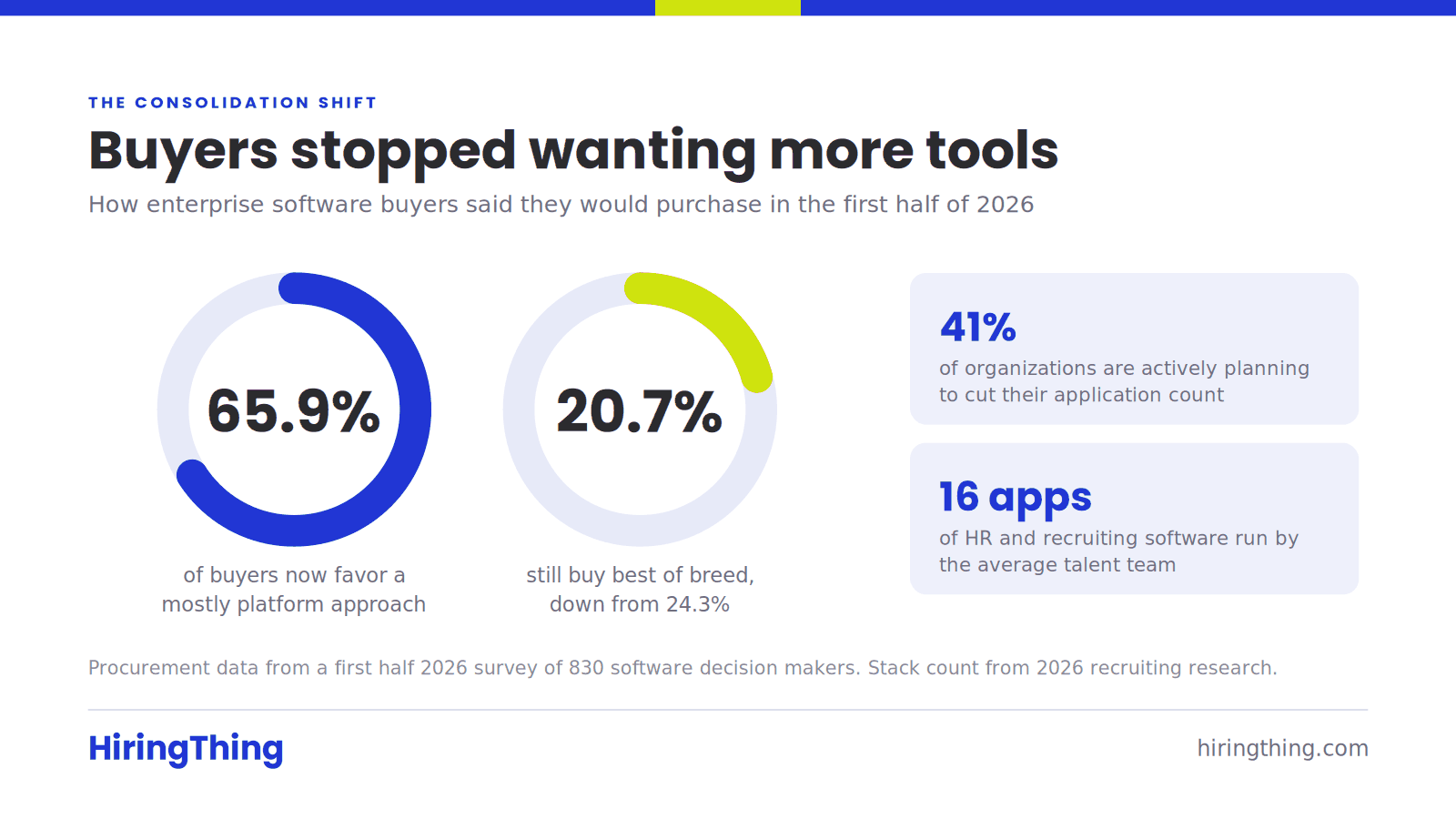
You can see why. The average talent team is running about 16 separate HR and recruiting applications, most of them barely used, and the average worker is bouncing between roughly 18 applications a day according to 2026 benchmark data covering more than 140,000 workers. Nobody wakes up wanting a seventeenth login.
This is not a subtle trend either. Nucleus Research found that small and midsize buyers are now judging platforms on how well they unify payroll, HR, and talent processes in a single system rather than on feature checklists. Meanwhile 15 of the 40 HR tech acquisitions tracked in the first quarter of 2026 existed to buy a capability the acquirer had not built, and five HCM platforms reached into recruiting and adjacent categories in that single quarter.
If your clients are consolidating and your competitors are buying their way into hiring, sitting still is a decision. Just not a good one.
What Happens When Hire Data Gets Typed Twice
This is the part that should bother you the most, because it is entirely avoidable and it lands on your product's reputation rather than the ATS vendor's.
When hiring lives in one system and payroll lives in another with nothing connecting them, somebody rekeys a new hire by hand. Name, address, tax details, start date, pay rate. That person is usually tired, usually doing it on a Friday, and usually working from a PDF or an email.
About 40 percent of payroll errors trace back to manual data entry, the average enterprise runs near 80 percent payroll accuracy, and organizations average around 15 corrections per pay period at roughly $291 each to fix. Roughly one in five payroll cycles still contains an error somewhere. Worse, 80% of the errors that do get caught are found by the employee, not the system.
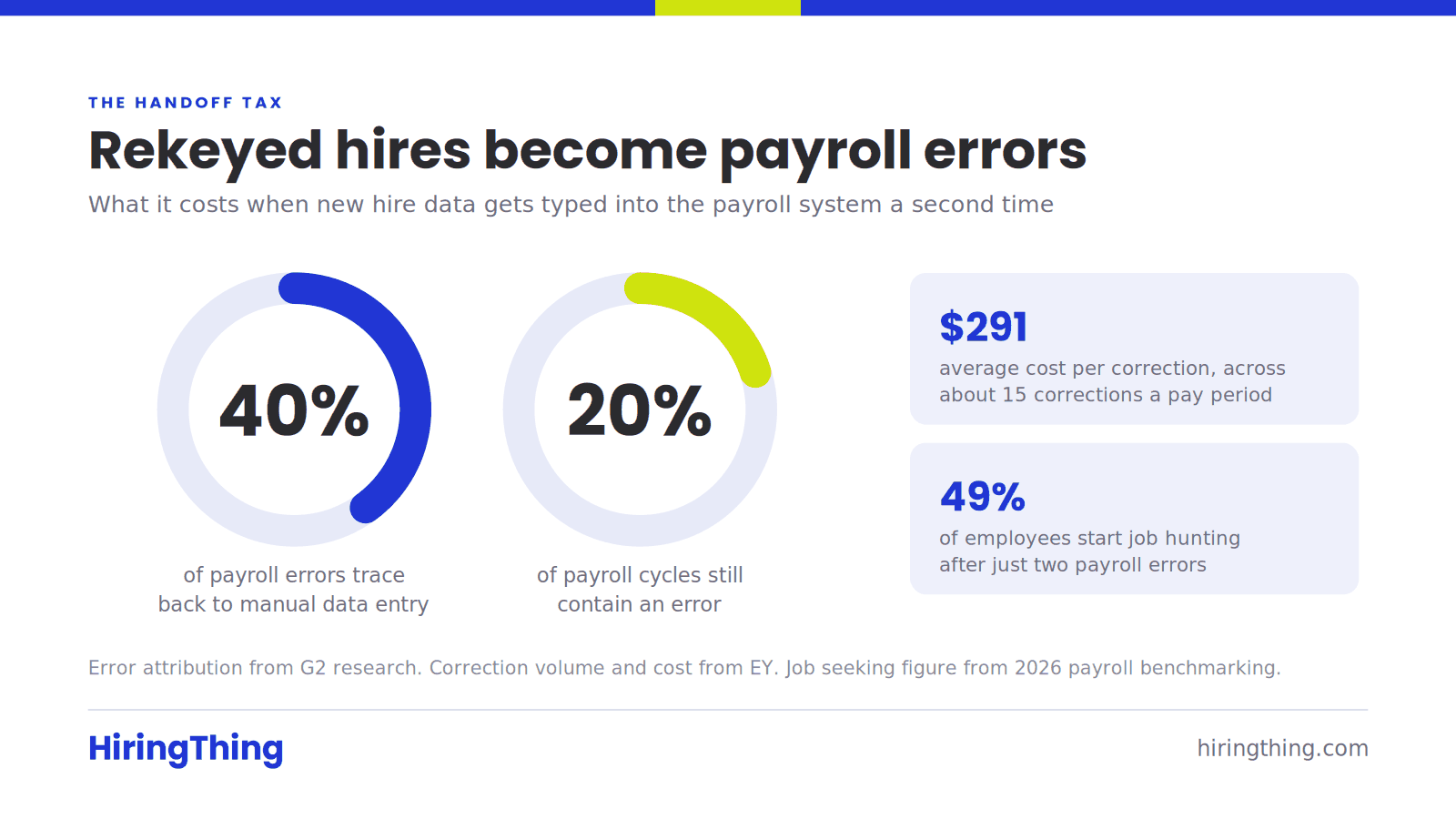
Now here is the number that turns this from an efficiency conversation into a retention conversation. Roughly 49 percent of employees start job hunting after two payroll errors. Two. Not five, not a pattern over a year. Two bad paychecks and half your client's new hires have their resume open again.
As Paycom put it in their own 2026 look at the problem, any HR tech that requires manual entry or transfer of data creates an opening for errors. That is common sense. The fix is also common sense. If the candidate typed their own information into your apply flow, that record should walk into payroll on its own when they get hired. Nobody should retype anything.

One Record, From Application to First Paycheck
The cleanest version of this is a single employee record that starts the moment somebody applies and never gets recreated.
A candidate applies through a branded careers page. They move through stages. They get an offer, they accept, and the moment that hire event fires, the record hands off into onboarding and then into payroll and benefits with the data already validated. No CSV. No copy and paste. No reconciliation project in week three.
That handoff is the whole ballgame, and it is worth being picky about. A serious white label applicant tracking system will expose a hire event carrying a full structured payload rather than a bare candidate ID that forces your engineers to make three more API calls to figure out who the person actually is. If you want the deep technical version of that argument, my colleague wrote up what the architecture and webhook requirements actually look like in 2026.
Compliance Gets Easier When the Data Starts Clean
Payroll people already live inside tax withholding rules, benefits deductions, overtime calculations, and wage and hour law. You know this territory better than we do.
What integrated hiring changes is where the data gets captured. When employment eligibility, classification, pay rate, and job details are collected during hiring in a structured way, they arrive at payroll clean and timestamped instead of being reconstructed later from someone's inbox. Audit questions get easier to answer because there is one trail instead of two systems telling slightly different stories about the same person.
Hiring also carries its own compliance surface now, including pay transparency posting rules that vary by jurisdiction and AI disclosure requirements for automated screening tools. Inheriting that from a vendor who maintains it full time is a much better trade than building it and then owning it forever.
Onboarding Is Where the Hire Sticks or Does Not
Getting somebody hired is not the finish line, and this is where a lot of payroll platforms leave money on the table.
Close to 38 percent of employees leave within their first year, and two thirds of those departures happen inside the first six months. The flip side of that same research is that organizations with strong onboarding improve new hire retention by 82 percent. That gap is enormous, and it is mostly a workflow problem rather than a mystery about human nature.
A new hire who spends their first week chasing forms across three systems and getting a paycheck with the wrong withholding has already formed an opinion about the company. Connected employee onboarding workflows that share a data model with hiring and feed payroll directly are the difference between a good first two weeks and a resignation in month four.

The Revenue Case, Which Is Probably Why You Are Still Reading
We are not going to pretend the customer experience argument is what gets a roadmap changed. Let's talk about the money.
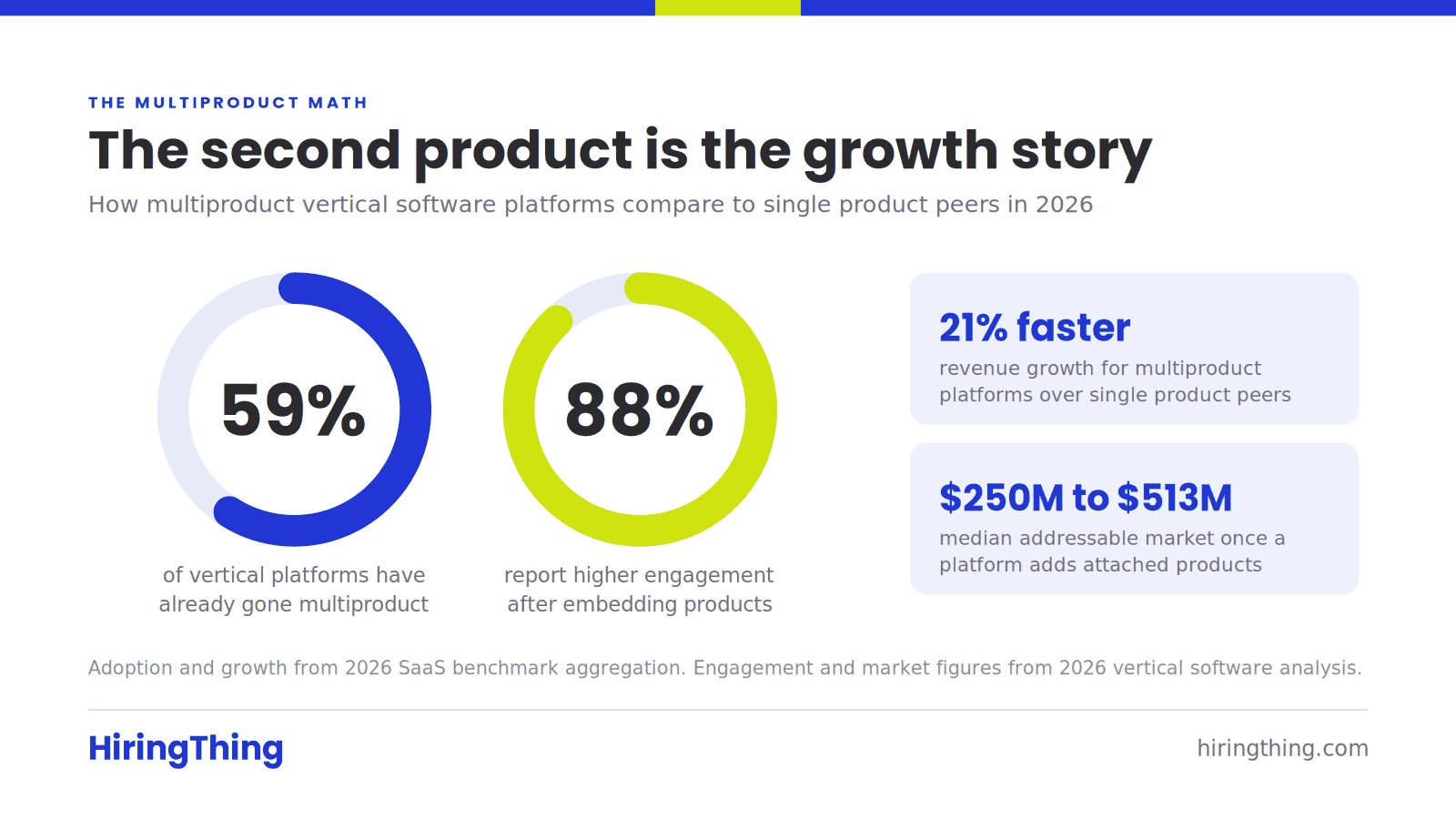
Multiproduct SaaS companies are growing roughly 21% faster than single product peers according to 2026 benchmark data, and 59 percent of vertical software companies have already crossed into multiproduct. Going multiproduct also moves the median addressable market from around $250 million to $513 million, and 88 percent of companies that embed additional products report higher engagement.
The payroll market itself gives you the reason to move now. Payroll and HR compliance software is worth about $25.59 billion in 2026 and headed toward $40.69 billion by 2031, and there are more than 5,700 payroll providers competing in the United States alone. Growth plus that much company means differentiation is not optional.
Distribution is the piece people underestimate. A national PEO that white labeled our ATS and turned it on by default for clients went from 146 hiring tenants to 1,959 in roughly two months. That is 1,813 new tenants in eight weeks, and it only works if the underlying platform was built for that kind of burst. If you want the full revenue breakdown, part two of this series goes deeper, and our 2026 vertical SaaS trends piece covers the broader pattern.
What I Would Do If I Ran Your Roadmap
Hiring is not a side quest for a payroll company. It is the front door to the record you already own, and in 2026 your clients are actively trying to buy fewer things from fewer vendors.
Build it yourself if you have the engineering appetite for job board integrations that break every quarter, an AI screening layer, and a compliance surface that keeps widening. Most teams look at that list honestly and decide to partner instead. Either way, the thing worth refusing to compromise on is the handoff. If a human has to retype a single field between the offer and the first paycheck, the integration is not done.
There is no reason to make your clients run two systems for one employee. Fix the seam, and the retention and revenue arguments take care of themselves.
About HiringThing
HiringThing is a modern recruiting and HR workflow platform as a service that creates seamless HR experiences. Our white label solutions and open API enable technology and service providers to offer talent software to their clients. Approachable and adaptable, the HiringThing HR platform empowers anyone, anywhere to strengthen their team.
Payroll and HR platforms use HiringThing to add applicant tracking, employee onboarding, and workflow management under their own brand, with the hire event wired straight into the systems their clients already run. If that is on your roadmap, start a discovery conversation or take a look at how we support HR technology platforms.
.jpg)


.jpg?width=45&name=1621426681866%20(1).jpg)