


White labeling a SaaS product promises a fast path to new revenue, but the architecture required to deliver on that promise is far more involved than the pitch suggests. Multi-tenant design is the foundation that determines whether a white label ATS scales gracefully across partners and clients or collapses under its own weight.
Summary
- Multi-tenant architecture allows one platform to serve many partners and their clients from a shared codebase while keeping every tenant's data, branding, and users fully isolated.
- Spinning up separate instances for each partner feels easier at first but becomes operationally unsustainable, consuming engineering capacity on maintenance rather than innovation.
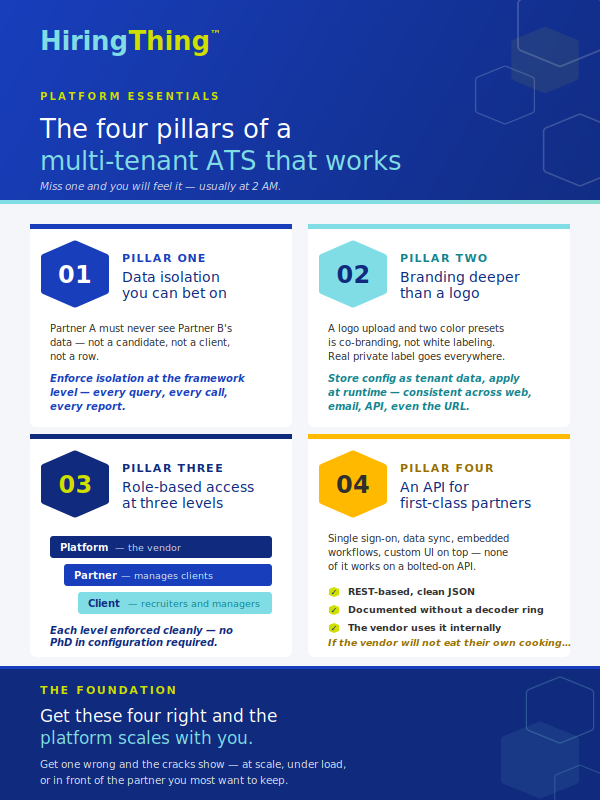
- A well-built multi-tenant ATS rests on four pillars: airtight data isolation, deep branding and configuration, role-based access control across vendor, partner, and client levels, and a genuinely open API.
- The most common architectural mistakes include forking code for customization, underinvesting in admin tooling, treating the API as an afterthought, ignoring tenant-aware observability, and deprioritizing security.
- When evaluating a partner, the right questions focus on true multi-tenancy, self-service configuration, full API coverage, upgrade control, and verifiable data isolation between tenants.

White labeling a SaaS product is one of those initiatives that sounds straightforward in a strategy deck and turns out to be considerably more complex in practice. The premise is appealing: the software already exists, partners simply need the ability to present it under their own brand, and the business unlocks a new channel with minimal additional investment. It is an attractive pitch, and for good reason.
The challenge surfaces as soon as engineering begins evaluating what the pitch actually requires. Supporting multiple partners, each with their own clients, their own branding, their own workflows, and their own data boundaries, is not a surface-level modification. It is a foundational architectural decision that shapes every layer of the product. Companies that recognize this early tend to build platforms that scale gracefully. Companies that do not often find themselves rebuilding later at considerable cost.
At the center of this decision is multi-tenant architecture. It is the framework that allows a single white label ATS to serve many partners, each with many clients, without compromising security, performance, or operational efficiency. Done well, it is largely invisible to end users and deeply empowering for partners. Done poorly, it becomes a long-term liability.
We will examine what multi-tenant ATS architecture involves, why it matters for organizations considering a white label partnership, and the characteristics that distinguish platforms engineered for partnership from those retrofitted to accommodate it.
What Multi-Tenant Actually Means (Without the Jargon)
A multi-tenant application is one piece of software that serves many different customers from the same codebase and, typically, the same underlying infrastructure. Think of it like an apartment building. One building, one plumbing system, one roof, but every tenant has their own locked door, their own furniture, their own photos on the wall. Nobody walks into the wrong unit. Nobody sees anybody else's stuff.
Now apply that to an applicant tracking system. In a well-built multi-tenant recruiting platform built for partners, each partner is a tenant. Inside each partner are their clients, who are also tenants in a way, each with their own jobs, candidates, hiring managers, and data. Nobody crosses streams. A client under Partner A cannot see a client under Partner B. The software knows who you are, what you are allowed to see, and what you are never allowed to touch.
This sounds obvious until you try to build it. Then it becomes the kind of thing you have nightmares about.
Why Single-Tenant Looks Tempting and Is Usually a Trap
A lot of SaaS companies start life as single-tenant applications. One customer, one database, one instance, one happy engineering team. When the first white label partner comes along and says they want the platform for their own clients, the temptation is enormous to just spin up another copy. Give them their own database. Their own instance. Their own little universe. Done.
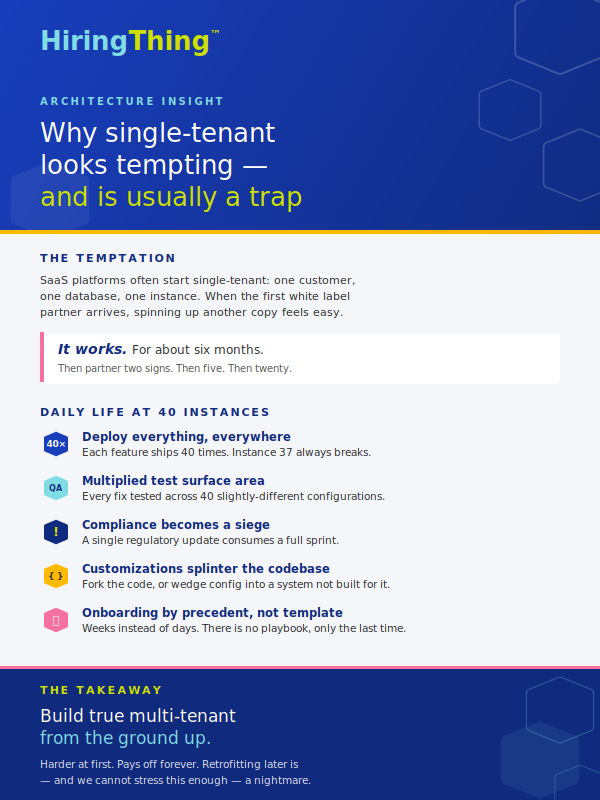
This works. For about six months.
Then the second partner signs. Then the fifth. Then the twentieth. Suddenly you are running forty instances of your own software, each on a slightly different version because deployment got weird last Tuesday, each with its own quirks, each requiring its own maintenance. Your engineering team is no longer building features. They are running a zoo.
Here is what daily life starts to look like:
- Every new feature has to be deployed forty times, and something always breaks on instance number thirty-seven.
- Every bug fix has to be tested forty times, across forty slightly different configurations.
- Every compliance update becomes a small siege that eats a full sprint.
- Every partner customization forces you to either fork the code (bad) or wedge configuration into a system that was not designed for it (also bad).
- Every onboarding takes weeks instead of days because there is no template, only precedent.
This is why companies that are serious about partnerships build true multi-tenant architecture from the ground up. It is harder at first. It pays off forever. If you want a sense of what that kind of foundation looks like in the wild, it is worth reading about the HiringThing Partner Experience, which was built around this model specifically because retrofitting it later is, and I cannot stress this enough, a nightmare.

The Four Pillars of a Multi-Tenant ATS That Actually Works
Here is where we get into the guts of it. There are a handful of things that make or break a multi-tenant ATS. Miss any one of them and you will feel it, usually at 2 AM when something breaks and you are trying to figure out whose data got where.
1. Data Isolation That You Can Bet the Company On
Data isolation is the thing that keeps Partner A from ever seeing Partner B's candidates, jobs, or client list. There are a few ways to do this. You can have separate databases per tenant. You can have separate schemas in a shared database. Or you can have a shared schema with tenant identifiers on every single row.
Each has tradeoffs. Separate databases give you the cleanest isolation but can be operationally heavy. Shared schemas are efficient but put enormous pressure on your access control logic, because one missed query filter and you have a very, very bad day. A lot of modern platforms use hybrid approaches, and the right answer depends on scale, compliance, and how much custom behavior different tenants need.
What does not have tradeoffs is the requirement that the isolation actually work. Every single query, every single API call, every single report has to know which tenant is asking and refuse to return anything that does not belong to them. This has to be enforced at the framework level, not left to the last developer who touched the feature to remember.
2. Branding and Configuration That Goes Deeper Than a Logo
White label is not just slapping a partner logo on a login page. When done right, the partner's brand is the experience. Their colors, their domain, their standards of service. A good multi-tenant ATS lets a partner configure all of this without touching code. It stores the configuration as data tied to the tenant, applies it at runtime, and keeps it consistent across web, email, and API.
This is where a lot of platforms fall down. They offer "customization" that turns out to mean you can upload a logo and pick between two color schemes. That is co-branding, not white labeling. A real white label solution gives the partner the ability to present the software as their own at every touchpoint. Even the URL.

3. Role-Based Access Control at Three Levels
An ATS serving white label partners has to handle roles at three different levels, and this is where the architecture gets genuinely tricky.
At the platform level, you have the vendor (the company that built the software). At the partner level, you have the white label partner's own team, who need to manage their clients without seeing the vendor's internal stuff. At the client level, you have the end users, the actual recruiters and hiring managers who need to manage candidates without seeing anything about the partner's other clients.
Each of these levels has its own permission structures, and the software has to enforce them without getting confused. A partner admin should be able to see all their clients. A client admin should be able to see all their own users. A hiring manager should see only the jobs they are assigned to. And none of this should require a PhD in configuration to set up.
4. An API That Treats Partners Like First-Class Citizens
This one is close to my heart, because I have seen so many platforms where the API was an afterthought and the partner experience was worse for it. If you are a white label partner, you are going to want to integrate the ATS into your core product. That means single sign-on, data sync, embedded workflows, maybe custom UI on top of the ATS data.
You cannot do any of that without a well-designed, well-documented, genuinely open API. The folks running HiringThing's developer program put a lot of care into this, and you can feel it when you work with the API. It is REST-based, it returns clean JSON, it is documented in a way that does not require a decoder ring, and the company actually uses its own API internally. That last one matters more than people realize. If the vendor does not eat their own cooking, you will eventually find the parts they never chewed.
The Hidden Benefits Partners Do Not Talk About
When the architecture is done right, the partner benefits go beyond "I can put my logo on it." A true multi-tenant white label ATS gives partners scale they could never achieve alone. New features appear for everyone at once. Security patches roll out to everyone at once. Compliance updates happen once, not forty times. The partner gets to benefit from every other partner's feedback, because when the vendor ships an improvement, the whole ecosystem moves up together.
There is also the small matter of not having to build the thing yourself. I have yet to meet a SaaS founder who said, "You know what, let's spend three years and seven million dollars building our own applicant tracking system from scratch." The math does not work, and even if it did, you would be building a thing that already exists instead of the thing that only you can build. The guide to white label SaaS partnerships over on the HiringThing blog lays this out better than I can here, and it is worth a read if you are on the fence.
Common Architecture Mistakes to Avoid
Since we are being honest, let's talk about the ways this goes sideways. I have seen all of these, and a few of them I have been responsible for. No judgment.
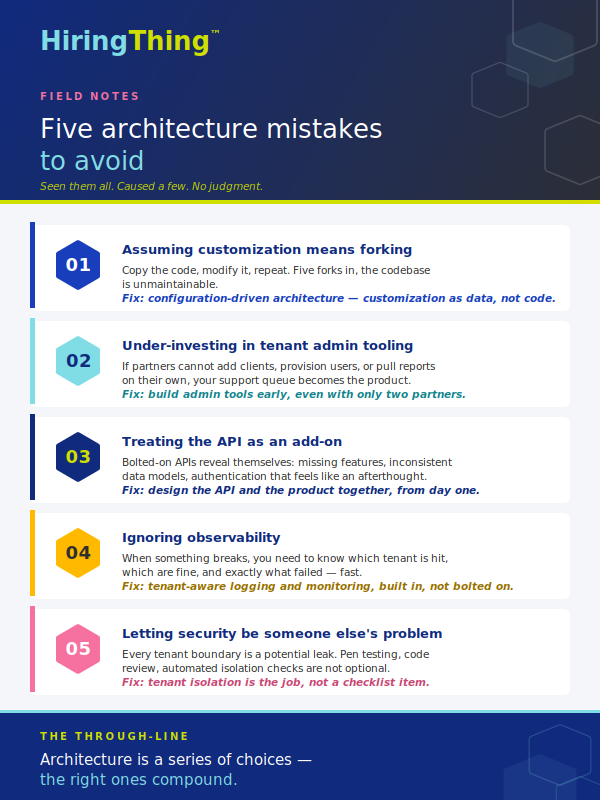
- Assuming customization means forking. Every time a partner asks for something custom, the easiest path is to copy the code and modify it. Do this five times and your codebase is unmaintainable. The right answer is a configuration-driven architecture where customization is data, not code.
- Under-investing in tenant administration tooling. If your partners cannot easily add clients, provision users, adjust branding, and pull reports without opening a support ticket, you are going to drown in support tickets. Build the admin tools early, even when you only have two partners. Your future self will thank you.
- Treating the API as an add-on. If the API came after the product, you can tell. Features are not available through it. Data models are inconsistent. Authentication feels bolted on. The platforms that get this right designed the API and the product together, which is one of the things you can feel in the difference between white label and private label platforms when you are evaluating them.
- Ignoring observability. When something goes wrong in a multi-tenant system, you need to be able to quickly figure out which tenant is affected, which tenants are not, and what exactly broke. Without proper tenant-aware logging and monitoring, you are debugging in the dark. With a flashlight. That is also broken.
- Letting security be someone else's problem. Every tenant boundary is a potential leak. Pen testing, code review, and automated checks for tenant isolation are not optional, they are the job.
How to Evaluate a Platform Before You Commit
If you are shopping for a white label ATS partner rather than building one, here are the questions I would be asking:
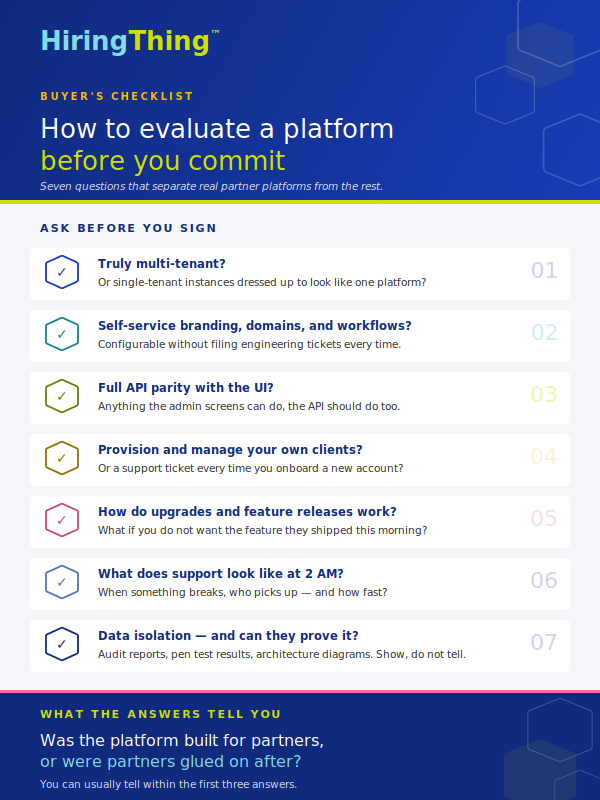
- Is the platform truly multi-tenant, or is it a collection of single-tenant instances pretending to be one?
- Can I configure branding, domains, and workflows without engineering help?
- Does the API cover everything the UI can do, or are there features I can only touch through the admin screens?
- Can I provision and manage my own clients, or do I have to file a ticket every time I add one?
- How do upgrades work, and what happens if I do not want a feature they just shipped?
- What does support look like when something goes wrong at 2 AM?
- How is my data isolated from other partners, and can they show me the proof?
The answers will tell you almost everything you need to know about whether the platform was built for partners or whether partners were an afterthought someone tried to glue on later. And yes, there is a whole guide to finding the right white label partnership that covers this in more depth if you want to get really thorough about it.
Why This All Matters
The companies that win in the white label space are not the ones with the flashiest demos or the biggest booth at the conference. They are the ones whose architecture quietly does the right thing, every time, at every scale, for every partner. The plumbing is invisible when it works, which is exactly how it should be. Your partners should be thinking about their clients, not about whether the underlying platform is going to hold up. Your clients should be thinking about their candidates, not about which vendor built what.
Good multi-tenant architecture is the thing that makes all of that possible. It is the foundation that lets a partnership become a real business instead of a science experiment. And once you understand what to look for, you will notice the difference immediately. The platforms that have it feel solid. The ones that do not, well, you can feel that too.
Build the foundation right, and everything else gets easier. Build it wrong, and you will spend the next five years wishing you had built it right.

About HiringThing
HiringThing is a modern recruiting and employee onboarding platform as a service that creates seamless talent experiences. Our white label solutions and open API enable HR technology businesses to offer hiring and onboarding to their clients. Approachable and adaptable, the platform empowers anyone, anywhere to build their dream team.

.jpg)