


Most teams start this search in the wrong place. They go shopping for an AI resume checker, sit through four demos of standalone tools, and never ask the question that actually matters: why is this a separate purchase at all? Screening happens against candidate records that already live in your applicant tracking system. This guide covers how to evaluate AI resume checking as what it should be. We’ll use HiringThing as a working example of how those feature choices look in a real product.
Summary
- A resume checker that lives outside your ATS creates a second copy of your most sensitive data, a second place your screening records live, and a workflow nobody follows consistently. Evaluate the feature, not the point solution.
- Your job descriptions do half the work. A thin posting produces a thin analysis, which is why most teams adopting AI screening end up rewriting their reqs first.
- Watch for the limits a vendor builds in on purpose: no names in the analysis, an account-level off switch, a retrievable record, and no hire recommendation.
- Backtest before you buy, the way you would with HiringThing's AI-assisted resume screening, which sits directly on the applicant profile rather than off to the side.
Every HR tech vendor with a pulse has bolted the word “AI” onto something in the last two years. Only some of it is genuinely useful. If you are the person stuck sitting through the demos, signing the contract, and then explaining the decision to your leadership team when a candidate files a complaint, you need a way to tell those two apart.
I have watched plenty of hiring teams buy screening software the way my brother buys tools at a garage sale, which is to say based entirely on how good it looks sitting on the table. There is a better way to go about it. Here are the things I would insist on knowing before anybody signs anything.

Start With Your ATS, Not With A Shopping List
Given two tools of roughly equal quality, take the one built into your applicant tracking system every single time. That is not a tiebreaker at the end of the evaluation. It is where the evaluation starts.
A standalone checker means exporting, uploading, waiting, and then manually carrying the results back into your process. That friction guarantees inconsistent usage, which guarantees inconsistent hiring. Your recruiter uses it on the roles where the pile got scary and skips it on the rest, and now you have two different screening standards inside the same company.
It also means your screening records live in one system and your candidate records live in another, which is exactly the situation you do not want when somebody asks you to reconstruct a decision. Screening that sits natively inside a white label applicant tracking system keeps the analysis attached to the applicant profile where it belongs, generated at the moment the application came in, stored alongside everything else about that candidate.
So the first question is not “which checker should we buy.” It is “what does our ATS already do here, and how good is it?” If the answer is nothing, that is a real gap, and the fix may well be changing platforms rather than bolting something on. The overview of how AI is reshaping recruitment tools is worth reading first, because it walks through where parsing ends and decision support begins. If you are building hiring tools for your own clients rather than buying for your own team, the guide to white label ATS software covers what that model looks like in practice. Either way, check the integrations list before you get attached to anything.
Everything below is a question to bring to your ATS vendor. Here they are on one page, if you want to skip ahead and take this into the demo.
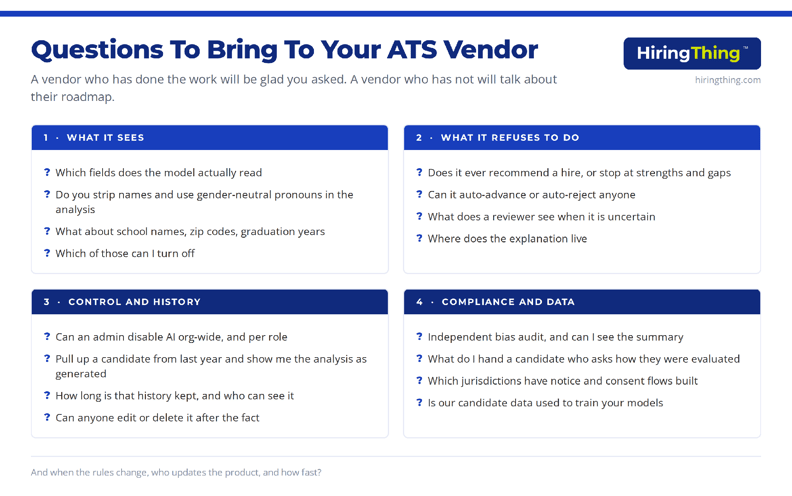 The whole evaluation, condensed. Every question below is expanded in the sections that follow.
Figure Out Which Feature You Are Actually Getting
“AI resume checker” gets used to describe at least four different things, and vendors are not in a hurry to clear that up for you.
- A parser pulls structured data off a resume. Name, dates, titles, skills. Useful plumbing, not a decision tool.
- A checker compares a resume against a job description and tells you where it lines up and where it does not.
- A ranker stack-orders your applicant pool and hands you a shortlist.
- A screener does some combination of the above and may auto-advance or auto-reject.
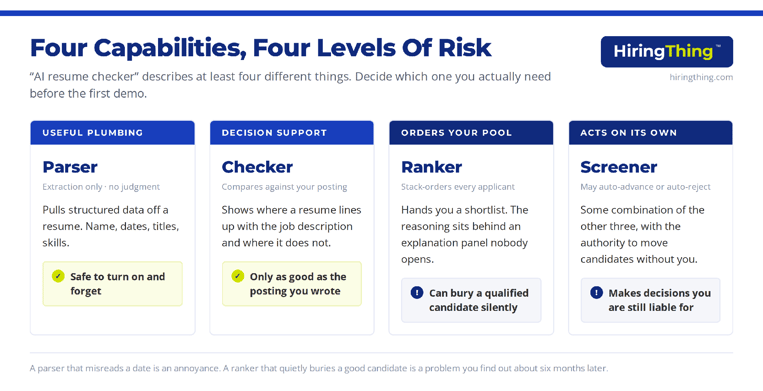 The four capabilities, and how much risk each one carries.
These carry wildly different amounts of risk. A parser that misreads a date is an annoyance. A ranker that quietly buries a qualified candidate is a problem you will not find out about for six months. Before the first demo, write down which of the four you need. If the sales rep will not say plainly which one their platform built, that is your answer.
Your Job Descriptions Are Half The Feature
This is the part nobody wants to hear. AI resume checking evaluates candidates against the job description you gave it. If that description is a nine-year-old copy-paste job with “bachelor's degree required” hanging off the bottom out of habit, the tool will faithfully hand you back exactly that bias, only faster and with more confidence.
Teams that turn on AI resume screening usually discover this in week one. The analysis comes back thin, and the reason is the posting was thin. That is not a software failure. That is the software holding up a mirror.
So before you evaluate anything, go read your most-used job descriptions out loud. If you would not defend a requirement in a room full of people, take it out. This is another argument for keeping the whole thing in one system: a platform that also offers AI job descriptions is working from the same posting the screening reads, and at minimum it forces you to add enough detail for the analysis to do real work.
Ask What It Does With Names
Ask this one early and watch the reaction. A feature that strips candidate names and uses gender-neutral pronouns in its analysis reflects a deliberate design choice to keep your reviewers focused on qualifications. One that hands your hiring manager a summary starting with the candidate's full name reflects a different choice, probably made by not thinking about it at all.
Names carry signals that have nothing to do with whether somebody can do the job. So do school names, zip codes, and graduation years. Ask which fields the model sees, which ones it shows the reviewer, and whether you can turn any of that off. The deeper argument for why this matters is laid out well in the piece on building a fairer, more diverse team with an ATS.
Find Out What It Refuses To Do
Counterintuitive, but the best signal in the whole evaluation. I trust screening more when the vendor tells me what it will not do.
The strongest implementations stop short of a hiring recommendation. They summarize strengths, flag gaps against the posting, and then hand it back to you. That boundary is not the vendor being timid. It is the vendor understanding that the moment software says “hire this one,” you have handed over a decision you are still legally and morally on the hook for.
An example of why this is important. Imagine a recruiter who ran a ranking tool for two solid years and never once opened the explanation panel. They just worked the top of the list. When somebody finally asked them why candidate fourteen scored the way they did, there was nobody in the building who could answer. Do not become that building.
Demand An Off Switch And An Audit Trail
There are two non-negotiables. Both are much easier to get from a native feature than from a bolt-on.
The off switch means an admin can disable AI features at the account level, for the whole org or for specific roles. You will want this the first time legal asks a hard question, or when you hire for something sensitive enough that you want a fully manual review. A separate subscription does not have an off switch so much as a cancellation.
The audit trail means you can reconstruct, months later, what the tool saw and what it said. Pull up an old candidate and show me the analysis that was generated at the time. When screening lives on the applicant record, that history is just part of the record. When it lives in a second system, you are hoping two retention policies happen to agree. If that history is gone, you cannot investigate a pattern, you cannot answer a candidate's request for an explanation, and you cannot defend yourself.
Compliance Is Not A Slide In The Deck
The regulatory floor keeps rising, and it is no longer theoretical. Bias audit requirements for automated employment decision tools, video interview consent laws, transparency and opt-out rules, and high-risk classifications for employment AI lives in various places. Courts have made it clear that an employer cannot hide behind the automated nature of its hiring tools when the outcome turns out to be discriminatory.
Questions to bring to the vendor:
- Has this been through an independent bias audit, and can I see the summary
- What documentation do you provide if a candidate requests an explanation of how they were evaluated
- Which jurisdictions have you built notice and consent flows for
- When the rules change, who updates the product, and how fast
That last one is where the split between feature and point solution shows up again. Notice and consent belong in the application flow, which your ATS owns. A screening tool sitting outside that flow cannot fix your consent language even if it wants to. Regulators have also published guidance on the questions buyers should ask AI recruitment vendors before they procure anything. Bring that list with you. A vendor who has done the work will be glad you asked. A vendor who has not will talk about their roadmap.

Where Your Candidate Data Goes
Resumes are dense personal data. Home addresses, employment history, sometimes more than a candidate meant to include. Get straight answers on three things.
Is candidate data used to train the vendor's models? Where is it stored and for how long? Who at the vendor can see it?
Then go look at the platform's actual security posture rather than taking the word of the person trying to close you.
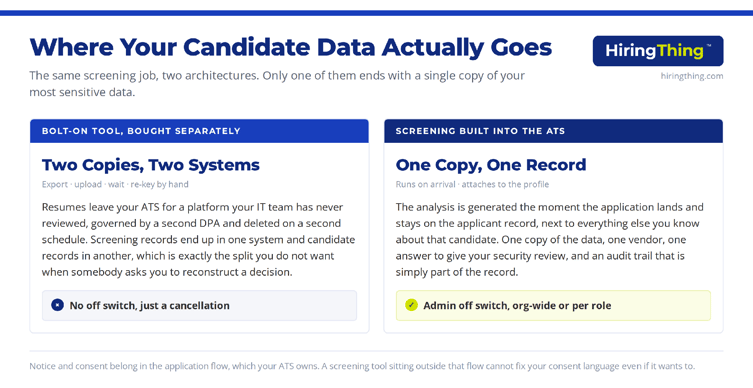 The same screening job, two architectures. Only one of them ends with a single copy of your candidate data.
This is the clearest case against the standalone option. A bolt-on that asks you to export resumes out of your system and upload them somewhere else has just created a second copy of your most sensitive data in a place your IT team has never reviewed, governed by a second DPA, deleted on a second schedule, breached on somebody else's timeline. When screening runs inside the ATS, there is one copy, one vendor, one answer to give your security review.
Test It On Roles You Already Filled
The single most useful thing you can do in a trial, and almost nobody does it.
Take three roles you filled in the last year. Run the original applicant pools through the feature. Then compare. Did it surface the people you actually hired? Did it surface strong candidates you passed over the first time? Did it bury anybody it should not have?
This takes an afternoon and tells you more than every case study in the sales deck combined. It is also dramatically easier when the applications are already sitting in the system doing the screening; there is no need to export, re-upload, just turn it on against pools you already have. If it misses a person you hired who is now doing great work, you want to know that before you commit, not after.
The Judgment Part Is Still Yours
There has always been a worry that automation will screen out good people. That worry showed up when applicant tracking systems first arrived. The truth is that most of the scary statistics people repeat about them turn out to be built on nothing at all. The honest version is simpler. Technology decides nothing on its own. People define what a qualified candidate looks like, and the software applies that definition at speed.
That is the whole argument for taking this decision seriously. Good AI resume checking gives every applicant a real read instead of a six-second skim, and buys your team back the hours that should go into conversations. A bad implementation takes whatever assumptions you walked in with and runs them across a thousand applications before lunch. The thinking on collaborating with AI in hiring holds up well here.

Go Run The Test
There is no secret to this. Start with what your ATS already does instead of shopping for a standalone tool, decide which of the four capabilities you need, clean up your job descriptions first, ask about names and off switches and audit trails, get real answers on compliance and data handling, and run your own old requisitions through it before you commit.
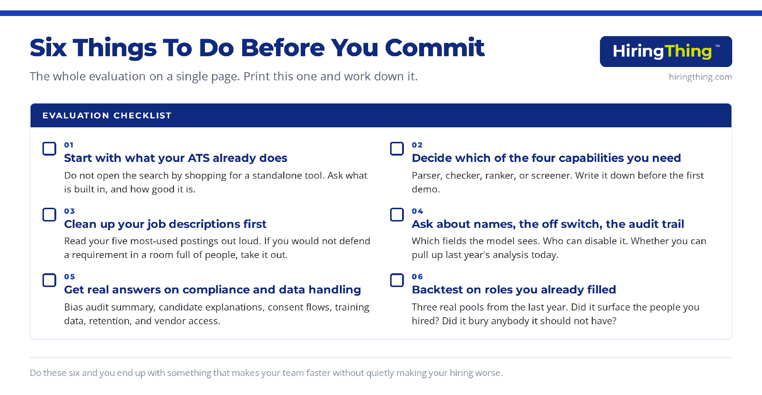 Print this one. It is the whole article on a single page.
Do those six things and you will end up with something that makes your team faster without quietly making your hiring worse. Skip them and you will find out what you bought eventually, just on a much less convenient timeline.
If you want to talk through what this looks like on your stack, the team at HiringThing is a reasonable place to start.
About HiringThing
HiringThing is a modern recruiting platform as a service that creates seamless talent experiences. Our white label solutions and open API enable HR technology businesses to offer hiring and onboarding to their clients. Approachable and adaptable, the platform empowers anyone, anywhere to build their dream team.

.jpg)