.jpg)
The applicant tracking layer inside large HRIS and payroll platforms has shifted from a feature checkbox into a load-bearing piece of partner infrastructure, and the technical bar for what counts as a credible embedded ATS rose sharply in 2025 and 2026. This article walks product and engineering buyers at multi-thousand-tenant platforms through the architectural questions, integration standards, and compliance pressures that now decide whether a white label ATS deployment scales gracefully or collapses under its own weight.
Summary
- Agentic AI in the candidate funnel is the 2026 forcing function, and any embedded ATS that cannot emit signed, low-latency webhooks for application, stage-change, offer, and hire events is structurally incompatible with where the AI recruiting category is going.
- True multi-tenant architecture is the real differentiator, resting on airtight data isolation enforced at the framework level, deep branding and configuration stored as tenant data, three-layer RBAC across vendor, partner, and end client, and a genuinely open API surface.
- One-click default-on distribution only works on properly partitioned tenant models, with public case data showing a single PEO going from 146 ATS tenants to 1,959 in roughly two months once the rollout was automated, a burst that breaks single-tenant SaaS architectures.
- The build-versus-partner math got harder in favor of partnering, because the compliance surface widened (EEOC, EU AI Act, NYC Local Law 144, FCRA, GDPR, CCPA), job board integration entropy keeps growing, and every partner client now expects AI-assisted screening baked in.
- Vendor evaluation should be done with running code, not slides, focusing on documented APIs and webhook payloads, programmatic tenant provisioning, branding scope down to custom domains and email sending, SOC 2 Type II posture, and a clean candidate-to-employee hire event that hands off cleanly to onboarding and payroll.
What the Engineering Math Actually Looks Like
If you run product or engineering at a payroll, HCM, orPEO platform with tens of thousands of worksite employers underneath you, the applicant tracking layer in your stack is no longer a checkbox feature. It has quietly turned into a demanded module on your roadmap, a common reason a client churns to a competitor, and an expensive thing to build correctly if you try to do it in-house.

This piece is for buyers evaluating white label and private label ATS infrastructure at the scale where multi-thousand-tenant partner-distributed deployments live. It assumes you already understand the commercial pitch. The goal here is to walk through the technical architecture, the integration surface area, and the failure modes that determine whether a partner deployment scales to 80,000-plus organizations or collapses at 2,000.
The 2026 Forcing Function, Agentic AI in the Candidate Funnel
A year ago, an embedded ATS was judged on whether it could post to a handful of mainstream job boards, score resumes with a basic match algorithm, and push hire records into payroll. That bar has moved.
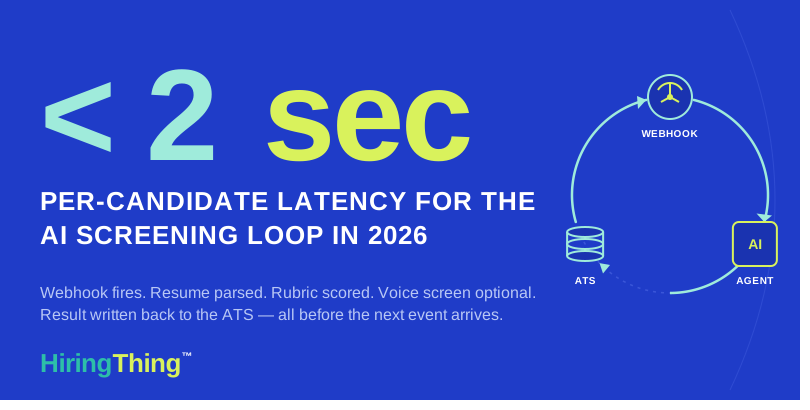
The new pattern, documented across the recruiting tech stack, looks like this. An AI agent watches a webhook stream from the ATS. When a new application lands or a stage changes, the agent fires within seconds, parses the resume, scores it against a structured rubric, optionally places a voice screening call, and writes results back as a candidate note or custom field. The AI screening, scheduling, and voice-agent category that emerged through 2025 and 2026 now expects this loop to complete in under two seconds per candidate, with MCP-native tooling pushing those expectations further every quarter.
A platform whose ATS cannot emit clean, low-latency webhooks for the core lifecycle events is structurally incompatible with where the market is moving.
Specifically, the AI integration partners coming through procurement in 2026 will ask for at least the following events, signed and replayible:
- application.created and application.updated, with the full candidate payload rather than a bare ID reference
- candidate.stage_changed, with both the prior and the new stage in the payload
- candidate.note_added and candidate.score_updated, so downstream agents can react to other agents
- offer.extended, offer.accepted, and offer.declined, with timestamps and acting user
- hire.completed, which is the event that should hand off to onboarding, payroll, and benefits
If the white label vendor cannot produce a sample payload for each of these in a discovery call, you have your answer. Most legacy ATS engines fail this test. They were built when polling every fifteen minutes was acceptable. It is not acceptable anymore. Real-time webhooks mean the AI tool acts on new candidates within seconds of arrival in the ATS, and the lag introduced by scheduled polling materially hurts candidate experience in high-volume environments. If you are at a payroll provider sitting on a million-plus worksite employees, that lag compounds into measurable damage to your partner clients' time-to-hire metrics.
Why True Multi-Tenant Architecture is the Real Differentiator
The single biggest hidden cost in white label ATS partnerships is not licensing. It is what happens when the underlying platform was retrofitted into multi-tenancy rather than built that way from day one.
A correctly designed multi-tenant ATS rests on four pillars:
- Airtight data isolation. Every query, every API call, every report knows which tenant is asking and refuses to return anything outside that boundary. That enforcement happens at the framework level rather than being left to whichever engineer last touched the feature.
- Deep branding and configuration. Settings are stored as data tied to the tenant and applied at runtime, consistently across web, email, and API surfaces, not as a logo upload and two color swatches.
- Role-based access control across three nested layers. The platform vendor, the white label partner (you), and the partner's end clients each have distinct permission scopes that cannot bleed across boundaries.
- A genuinely open API surface that exposes the same primitives the vendor uses internally, rather than a thin wrapper that lags behind the product by a release cycle.
If your white label vendor cannot show you their tenant isolation model in a security architecture review, walk. Cross-tenant data leakage in an ATS, where one partner client suddenly sees another partner's candidate pipeline, is not a recoverable incident. It is a regulated-data breach involving resumes, EEO data in many cases, and protected class information. The legal and reputational fallout outlives the partnership.
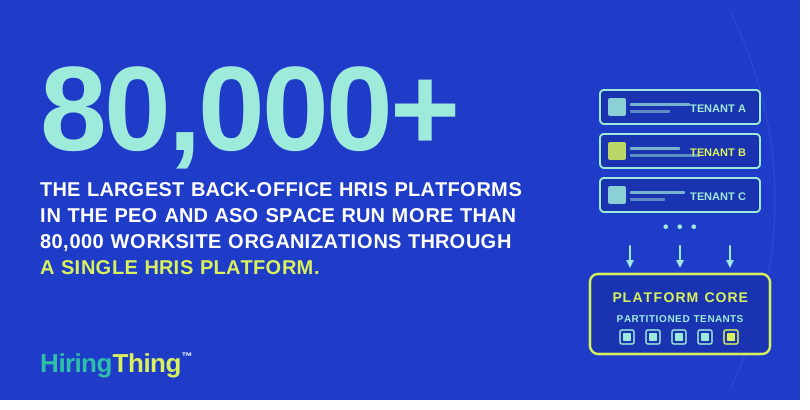
This is also where vendor scale becomes a feature rather than a vanity metric. The largest back-office HRIS platforms in the PEO and ASO space run more than 80,000 worksite organizations through their pipes, and partner-validated marketplaces exist precisely because that scale demands properly partitioned tenants. The general lesson from those deployments is consistent. Platforms that built true multi-tenancy from the ground up scale gracefully. Platforms that retrofitted it end up rebuilding later at considerable cost, often during the worst possible quarter.
The often-cited proof point of how distribution math works at this scale comes from a published case study that we did on a national PEO client that white labeled the HiringThing ATS and pushed it to every client by default. In a roughly two-month window after rolling out a one-click default-on program, the ATS user base went from 146 clients to 1,959 clients. That is 1,813 new tenants in eight weeks. That kind of distribution only works if the underlying tenant model can absorb the burst without provisioning new instances per client. Single-tenant SaaS architectures cannot do this. Period.
The Integration Surface, What a Serious Technical Buyer Should Evaluate
The four integration patterns that now define ATS interoperability are well established.
A useful taxonomy that the recruiting tech community has converged on breaks them down into four categories:
- Native marketplace connectors, where the ATS vendor or the integration partner ships a maintained, opinionated bridge with click-to-install onboarding
- Open API plus webhook, where the partner builds against documented REST endpoints and subscribes to event streams
- iPaaS automation through general-purpose integration platforms that sit between the two systems and handle transformation, orchestration, and error handling
- Browser-extension overlays, which screen-scrape recruiter UI as a last resort when no real API exists
A white label ATS that intends to power an HRIS, payroll, or HCM platform's recruiting layer needs to credibly support the first three. The fourth is a recruiter convenience, not an infrastructure feature, and any vendor positioning a Chrome extension as their integration story should be treated with skepticism.

Concretely, here is the checklist worth running against any white label ATS vendor at the scale of distribution you are planning.
REST API Surface
- Are candidate, application, job, stage, requisition, offer, and user objects all first-class with full CRUD coverage?
- Are custom fields treated as first-class data, queryable through the same endpoints, or are they shoved into a flat key-value bag?
- Is pagination cursor-based, with stable ordering, or offset-based and prone to skipping records under concurrent writes?
- Is rate limiting documented per partner tenant rather than across the whole platform, so one noisy tenant cannot throttle another?
- Is the API versioned, with a deprecation policy, or does the vendor break things at their convenience?
The vendors that take this seriously publish developer documentation hubs with endpoint references and workflow guides rather than gating them behind sales calls. If the documentation is gated, the API is probably not as mature as the deck claims.
Webhook Hygiene
- What events fire? Is the catalog complete enough to drive an event-sourced downstream system?
- What is the at-least-once or exactly-once delivery guarantee?
- Is there a replay endpoint for events missed during a partner outage, with a documented retention window?
- Is the signing scheme HMAC-SHA256 with a per-tenant secret, or something weaker?
- Is each event idempotent, with a stable event ID that consumers can dedupe against?

Webhook execution counted against API rate limits is increasingly standard and worth asking about, since AI-driven workflows can multiply that volume by an order of magnitude over a baseline year.
Identity and Authentication
- SCIM 2.0 provisioning, so partner clients can manage their user lifecycle from their own identity provider
- SAML 2.0 and OpenID Connect SSO, with per-tenant IdP configuration
- OAuth 2.0 client credentials and authorization code flows, scoped per partner
- API key management that supports rotation without downtime
These are not optional anymore. A partner client whose IT team cannot wire the ATS into their enterprise identity provider in an afternoon will escalate the problem to you, not the vendor.
Data Residency and Isolation Primitives
Logical isolation in a shared database with row-level security is fine when implemented correctly. Per-tenant schemas or per-tenant databases are sometimes required for regulated verticals. The vendor should be able to articulate which model they use, why, and what their migration path looks like if a large partner client needs an isolation upgrade later.
Audit Logging at the Field Level
For a partner subject to client audits, every change to a candidate record, every stage move, every offer extended needs an immutable audit trail accessible through the API. EEO defensibility, pay transparency compliance, and the EU AI Act's requirements for high-risk hiring systems all depend on this.
The Off-boarding Path from Candidate to Employee
A PEO or payroll partner is integrating the ATS so that hire-record data flows cleanly into onboarding, then into payroll, benefits enrollment, and tax setup. The white label vendor should expose a hire event that includes a structured payload of everything downstream systems need, not just a candidate ID that forces the partner to re-fetch and reconcile across three API calls. The cleanest implementations also offer companion employee onboarding workflows that share a data model with the ATS, so the candidate-to-employee transition does not require a translation layer.
The Build-Versus-Partner Math, Updated for 2026
The traditional argument for partnering rather than building was time-to-market and engineering opportunity cost. That argument got stronger this year, not weaker, because of three compounding factors.
The Compliance Surface Widened
EEOC reporting requirements, the patchwork of state-level pay transparency laws, the EU AI Act's classification of automated hiring tools as high-risk systems, and a wave of state-level AI hiring disclosure rules have all landed in the past eighteen months. A platform that builds its own ATS now inherits all of that compliance work. A platform that white labels offloads most of it to the vendor.
The specific items on a 2026 compliance checklist for an embedded ATS include the following:
- EEOC EEO-1 data collection and reporting infrastructure
- Pay transparency posting requirements that vary by jurisdiction and trigger on different employer thresholds
- AI hiring disclosure requirements (NYC Local Law 144, the Illinois AI Video Interview Act, the EU AI Act, and similar regimes)
- Background check consumer report compliance under FCRA and state analogs
- Data retention and deletion policies aligned with GDPR, CCPA, and state-level privacy laws
Job Board Integration Entropy Increased
The major general-purpose job boards, the niche industry boards, the aggregators, and the explosion of programmatic job advertising vendors each have their own ingest formats, posting APIs, and apply-flow handoffs. A serious ATS vendor maintains all of those connections as a core part of the product. A platform building in-house has to maintain them too, forever, against a moving target. Every quarter, one of those boards changes a field or deprecates an endpoint, and that maintenance work never ends.
The AI Integration Tax Became Unavoidable
Every partner client now expects, at minimum, AI-assisted job description generation and resume screening. Building this layer in-house means staffing an ML team and signing your own LLM contracts. Partnering means inheriting it through the ATS vendor's existing integrations or through the open API surface that the vendor maintains so third-party AI agents can plug in. The build option also commits you to ongoing model evaluation, prompt versioning, and the compliance burden of being the AI provider rather than the integrator.
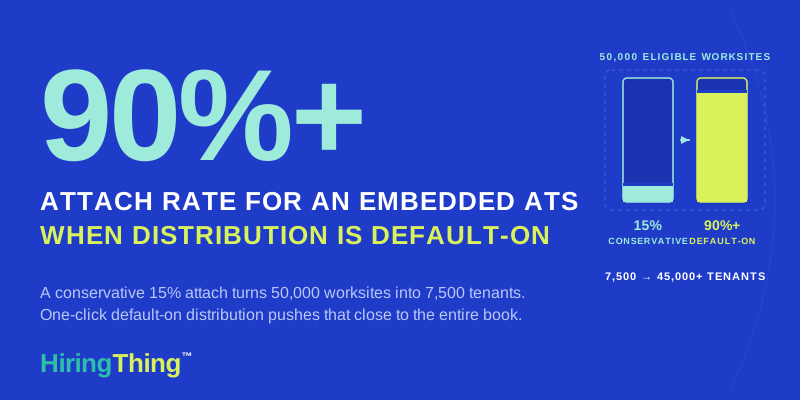
Run the numbers on a platform with 50,000 worksite employers. Even at a conservative 15 percent attach rate for an embedded ATS module, that is 7,500 paying ATS tenants. The published case data suggests the actual attach rate when distribution is one-click via a default-on program is closer to ubiquitous, well above 90 percent of the eligible book. The revenue math at that volume is straightforward. The engineering math, the question of whether you can ship and maintain that surface area in-house, is where most platforms quietly decide to partner.
What to Actually Ask in the Vendor Evaluation
Skip the marketing pages. The questions that separate a deployable white label ATS from a demo-quality one are concrete and answerable in a working session.
Use this as your discovery agenda:
- API documentation. Show me the public docs with example payloads. If the docs are gated behind a partner agreement, the API is probably not as mature as the sales deck claims.
- Sample webhook payload and signature verification. Show me application.created with the full candidate object and the HMAC verification code in two languages. If they cannot produce this in the meeting, they are not ready to power your partner channel.
- Partner administration model. How do I, as the partner, provision a new client tenant programmatically? How do I bulk-provision 1,800 tenants in a default-on rollout without filing a support ticket?
- Branding configuration scope. Custom domain with partner-controlled DNS? Per-tenant email templates with custom sending domain? Custom career-page templates editable as code or only through a WYSIWYG? Branded mobile-responsive apply flow with no vendor logos in any user-facing surface?
- Data export path. If a partner ends the relationship, what is the contractual and technical mechanism for getting candidate, application, and hire data back out at scale, in a documented schema? What is the SLA on that export?
- Security posture. SOC 2 Type II report, penetration test summary from the last twelve months, subprocessor list, and incident history. At your tier of distribution, those documents are going to be reviewed by the security teams of partner clients, and gaps in the vendor's posture become your gaps.
- Tenant isolation proof. Walk me through, in code, how a query in your application layer prevents Partner A from reading Partner B's candidate records. If the answer involves a WHERE clause that a developer has to remember to add, that is the wrong answer.
- Upgrade and migration policy. When you ship breaking changes, how much notice do partners get? Is there a sandbox environment that mirrors the production data model?
- Roadmap transparency. Do partners get visibility into the next two quarters of product development, or are you reading press releases at the same time as your clients?
The Bottom Line for Technical Buyers
The white label ATS category has matured to the point where the architectural questions matter more than the feature checklist. Multi-tenant isolation, webhook quality, API completeness, and the off-boarding event schema into payroll and onboarding systems are now the decisive criteria. A vendor that built around partner distribution from day one will look meaningfully different under technical due diligence than a single-tenant SaaS that bolted on a partner program later.
The signal to watch in vendor selection is whether the company treats the partner channel as a first-class customer or as a tier of resellers underneath their direct sales motion. The former invests in administration tooling, API depth, and dedicated integration partner programs. The latter cuts those investments first when the budget tightens, and you find out a year into the contract.

For platforms at the largest scale of HRIS, PEO, and payroll distribution, or aspiring to that scale, the partnership decision is no longer about whether to embed an ATS. It is about whether the embedded ATS can survive the next two years of AI-agent integration pressure, compliance expansion, and one-click rollout expectations from partner clients. Pick the vendor that can answer the questions above with running code, not slides. The cost of picking wrong is paid in churn, security incidents, and a rebuild project that consumes the roadmap for the eighteen months you cannot afford to lose.
About HiringThing
HiringThing is a modern recruiting and HR workflow platform as a service that creates seamless HR experiences. Our white label solutions and open API enable technology and service providers to offer talent software to their clients. Approachable and adaptable, the HiringThing HR platform empowers anyone, anywhere to strengthen their team.