
The hiring market moves into May 2026 in a familiar stall, with job openings holding steady, applications surging, and actual hires crawling along at the slowest pace in years. Behind the stagnation sit three overlapping stories worth understanding if you are hiring, job hunting, or simply trying to make sense of where the labor market goes next.
Summary
- The labor market remains locked in an eighteen-month "low-hire, low-fire" pattern, with 6.9 million job openings but hires dropping to 4.8 million in February and quit rates at pre-pandemic lows.
- Tech layoffs continue to drive headlines, with 52,050 first-quarter job cut announcements led by Oracle, Meta, Snap, and Disney, roughly a quarter officially attributed to AI and the rest tied to cost discipline and 2021 overhiring corrections.
- Application volume has doubled since 2022, fueled by a larger candidate pool, widespread use of AI tools to generate resumes, and employers stretching time-to-hire to around 42 days.
- Employers winning in this environment are the ones building pipelines ahead of need, posting salary ranges, shortening their applications, and using modern ATS technology to manage the flood of candidates.
The first week of May 2026 has served up one of the more unusual hiring environments we have seen in years. Job openings are still out there. Applications are pouring in at record volume. And almost nobody is actually getting hired. Employers are not firing people either, outside of a few high-profile tech names. The whole market sits in place, humming along, going nowhere.
Economists have a phrase for this. They are calling it "low-hire, low-fire," and the team tracking labor data for the country's largest job board has been flagging the pattern since late 2024. We have now crossed eighteen months of the same dynamic. That is not a blip. It is the environment.

What the Numbers Show
Job openings sit around 6.9 million according to the most recent federal labor turnover report. That sounds healthy until you look at the other columns. Hires dropped to 4.8 million in February, and quit rates have fallen to levels not seen since before the pandemic. People are not leaving their jobs, and employers are not filling open seats. Everyone is standing still and watching everyone else.
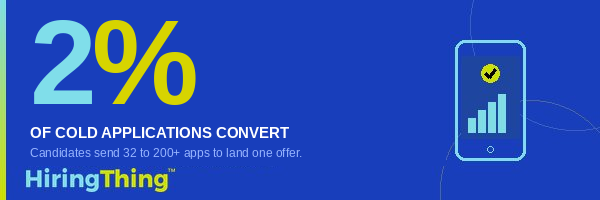
Applications tell the other half of the story. A five-year analysis of HR platform data shows applicant volume has surged since 2021 while completed hires have declined every year since 2022. We pulled together the raw numbers in our job application statistics roundup, and the short version is stark. Candidates now submit between 32 and 200-plus applications to land a single offer. Only 0.1 to 2 percent of cold online applications convert to anything at all.
More volume. Fewer hires. A funnel getting longer and narrower at the same time.
The AI Restructuring Story
Tech is where the "fire" part of low-hire, low-fire still shows up. April was not quiet. Oracle's April 1 reduction cut roughly 10,000 employees, with estimates running as high as 30,000 before the restructuring is complete. The company reported strong earnings shortly before the cuts. This was not a rescue. It was a reallocation, and that word matters.
Reporting out this week puts Meta on a path to cut up to 10 percent of its workforce while suspending recruitment on roughly 8,000 open roles. Snap eliminated around 1,000 positions, about 16 percent of its staff. Disney took another 1,000, mostly in marketing. The common thread is not financial weakness. Several of these companies are profitable. The common thread is a strategic bet that fewer humans plus more AI infrastructure will generate better returns.
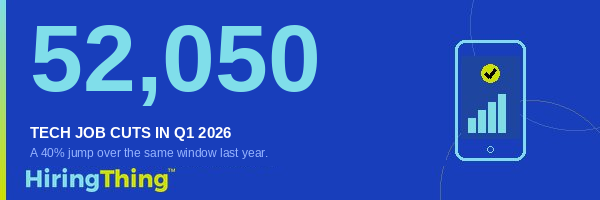
Data shows 52,050 tech sector job cut announcements in the first quarter of 2026, a 40 percent increase over the same window in 2025. About a quarter of March's total cuts were formally attributed to AI and automation. The remaining three-quarters trace back to cost discipline, business unit restructuring, and a long overdue correction to the cheap-capital hiring surge of 2021.
Few executives want to say "we overhired." Many are willing to say "AI efficiency gains." Even the CEO of one of the major AI labs has acknowledged that some "AI washing" is built into the public explanations. That tracks with what the numbers suggest.
Why Inboxes Are Overflowing
If you run hiring at a company right now, your problem is not finding candidates. It is sorting them. A recent recruitment statistics report found that applications per role have doubled since spring 2022, and a quarter of employers now rank managing application volume as one of their top hiring challenges.
Three things are driving the flood.
First, more people are looking. Over half the global workforce said they were hunting for something new coming into 2026. Tens of thousands of federal workers entered the market earlier this year, and their application rates remain roughly 150 percent above last year's levels. A wave of tech layoffs added more skilled candidates to the pool. The pool keeps filling.

Second, AI has made applying nearly free. Job seekers can tailor a resume to any posting in about thirty seconds. Nearly half of candidates report using AI tools in their job search, and close to 80 percent plan to apply to more jobs than they did last year. Candidates submit fifty applications on a Saturday morning, and every resume reads as a tight match for the job description. That is the problem.
Third, employers are moving deliberately. Time to hire has stretched to around 42 days. When quit rates drop, the urgency to replace a departing employee drops with them. Nobody is leaving, so nobody has to be replaced in a hurry, so every open requisition gets the full six-week treatment. Screening stretches. Interviews stretch. Offers stretch. Qualified candidates sit waiting.
What 42 Applications and a Ghost Post Add Up To
There is a cost to all of this that does not show up cleanly in the government data. Career practitioners writing about this market note that job seekers now face roughly 42 applications per interview with an interview-to-offer funnel that rarely converts. Somewhere between 18 and 22 percent of job postings may be ghosts with no real hiring intent behind them.
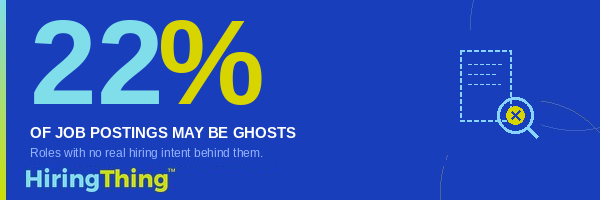
If you are a candidate, you are spending time on roles that do not exist. If you are an employer, you are wading through applications from bots, from people applying without reading the description, and from a pile of genuinely qualified humans you cannot tell apart because AI-tailored resumes have started to look identical. One recruiter quoted in the piece put it directly. Employers are seeing more applicants but fewer quality applicants, and strong candidates are getting rejected because their human-written resume does not look as polished as an AI-generated one.
That is the market in April 2026. A standoff framed as efficiency.
What Works in This Environment
A few things move the needle, and most of them come down to fixing the hiring process itself rather than waiting on the macroeconomy.
If you are hiring, build a pipeline before you need it. Organizations with pre-built talent pipelines hire twice as fast and see three times the offer acceptance rate. Post salary ranges, since four in ten candidates will skip a listing that hides compensation. Shorten your application. Sixty percent of candidates abandon applications because of length or complexity, and if your form takes twenty minutes to complete, the only people finishing it are the ones without other options.
And use the right tools. When 250 applications land on a single posting, a modern applicant tracking system stops being a nice-to-have and becomes the difference between closing a hire this quarter and still discussing it in September. We happen to build one, so weigh that recommendation accordingly, but the underlying point holds regardless of vendor. The employers getting offers accepted in 2026 are the ones treating their hiring process as something that matters to the candidate, not just to the finance team approving the headcount.
If you are job hunting, referrals remain the strongest channel. Referred candidates are seven times more likely to be hired than job board applicants, and the process runs 29 days rather than 55. Networking is unglamorous and slow, and it is still the single most reliable way in. Ten thoughtful applications will outperform a hundred AI-generated ones in a market this saturated.

What's Coming
The low-hire, low-fire economy is not permanent. Eventually the frozen middle thaws, either because rates shift, or because enough people break the stalemate by changing jobs anyway, or because the AI productivity story either delivers on its promises or gets recognized as the convenient talking point it sometimes is. We have been through stranger stretches than this one.
For the moment, the first full week of Mayl 2026 stands as a case study in a job market where the headline numbers look stable while the “positive” experience on both sides of the table continues to deteriorate. Candidates sending hundreds of applications into the void. Employers are drowning in resumes they cannot differentiate. And a growing sense that everyone is waiting for someone else to move first.
About HiringThing
HiringThing is a modern recruiting and HR workflow platform as a service that creates seamless HR experiences. Our white label solutions and open API enable technology and service providers to offer talent software to their clients. Approachable and adaptable, the HiringThing HR platform empowers anyone, anywhere to strengthen their team.

.jpg?width=45&name=1621426681866%20(1).jpg)