.jpg?width=45&name=1621426681866%20(1).jpg)

SaaS growth rarely comes from standing still. The companies that keep momentum going are usually the ones that find smart ways to expand what they offer without losing focus on what they already do well.
Summary
- White labeling helps SaaS companies add new solutions without building every product from the ground up
- It creates opportunities to strengthen branding, improve retention, and deliver a more unified customer experience
- It can reduce development costs, shorten time to market, and make it easier to test new markets
- Private labeling takes the model further by allowing greater customization and alignment with business needs
Why White Labeling Matters in SaaS
SaaS companies are under constant pressure to grow, innovate, and deliver more value at the same time. Customers want platforms that solve multiple problems, not just one, and that expectation continues to rise as software becomes more central to everyday operations. They also want convenience, simplicity, and experiences that feel connected rather than fragmented across a dozen different tools. When buyers start to feel like their stack is working against them, they begin looking for partners that can simplify the experience and reduce friction across their workflows.
That is one reason white labeling has become such an appealing strategy. It gives companies a way to expand their product offerings without having to build every new solution internally, which can quickly drain time, budget, and attention from the products that matter most. Instead of investing months of engineering time into something uncertain, a SaaS business can bring in proven software from a trusted partner and present it under its own brand. This approach allows teams to stay focused on their strengths while still moving forward in a meaningful way.

In practical terms, white labeling means one company creates the software and another company rebrands and sells it as part of its own platform. In the SaaS world, that can mean adding a new capability, launching a complementary solution, or broadening a product suite much faster than would otherwise be possible. For many businesses, that speed is not just helpful. It is essential to staying relevant in a market that changes quickly and rewards companies that can respond without hesitation.
What White Labeling Means in the World of SaaS
White labeling is the practice of rebranding a product or service produced by another company so it appears to be your own. In software, this usually means taking an existing platform and applying your own name, design elements, and customer facing identity to it. The end result feels like a natural extension of your product, even though the technology originated elsewhere. To the customer, the experience stays centered on your brand.
The concept sounds simple, but the business impact can be significant when it is applied thoughtfully. A company that white labels software can offer customers a broader experience without taking on the full burden of designing, building, testing, and maintaining a brand new product. That creates flexibility, especially for organizations that want to move fast but do not have unlimited internal resources. It also gives leadership teams more options when deciding how to grow without introducing unnecessary risk.
Offer More Solutions Without Building Everything Yourself
One of the clearest reasons SaaS companies white label new solutions is because it allows them to offer more to their customers. A business may be excellent at one core product, but customers often need adjacent tools as well, and those needs do not go away simply because your roadmap is full. Instead of sending them elsewhere, white labeling creates a path to keep those solutions under the same brand umbrella. This approach allows companies to stay present in more parts of the customer journey.
That matters because customers prefer convenience, even when they do not explicitly say it. When they can access more of what they need from one provider, the relationship often becomes stickier and more valuable over time. The company is no longer just delivering a single piece of software. It is becoming a more embedded partner in the customer’s day to day operations. That deeper level of relevance can make renewal conversations easier and expansion opportunities more natural.
There is also a strategic advantage here that goes beyond convenience alone. The more useful your ecosystem becomes, the harder it is for competitors to displace you or lure customers away. A broader solution set can improve retention, increase average customer value, and attract new buyers who are looking for a more complete platform. It allows your business to grow not only by selling more to existing customers, but also by becoming more attractive to prospects who are tired of piecing together disconnected tools.
Present New Solutions as Proprietary
White labeling also allows SaaS companies to introduce new capabilities as part of their own branded experience, which can be a powerful differentiator in crowded markets. When a product carries your brand, your design language, and your positioning, customers experience it as part of your company’s offering rather than as a third party add on. That consistency builds familiarity over time. It also gives you more control over how value is presented and understood.
That creates a smoother and more cohesive journey for users who may already be managing multiple systems. It helps reinforce the idea that your business is evolving to meet customer needs instead of standing still. This perception can play a meaningful role in how customers evaluate your long term value, because companies that appear responsive and forward moving tend to earn more confidence.
Save Time and Money
Developing a new SaaS solution from scratch is expensive, and it is also unpredictable in ways that are not always obvious at the beginning. Even when companies begin with a clear roadmap, software projects often take longer and cost more than expected. Requirements change, priorities shift, and unexpected technical issues appear at exactly the wrong moment. That uncertainty can slow down growth and create internal pressure far beyond the product team.
A market viable product can require a substantial upfront investment before it even reaches customers. Then come the ongoing costs of maintenance, improvement, support, security, and infrastructure, which often exceed the initial build over time. In many cases, the most expensive part of a software product is not building version one, but everything that follows. Once a product is live, it needs attention constantly, and that demand does not fade.
Time is another major factor that cannot be ignored. New solutions can take months to build, and that timeline does not always include hiring or onboarding the people needed to execute the work effectively. By the time the product is ready, the market may have shifted or customer expectations may have evolved again. White labeling changes that equation by allowing companies to use software that already exists and has already been refined.
That does not mean white labeling is effortless or requires no coordination. It still involves onboarding, positioning, sales readiness, and ongoing collaboration with a partner. But compared with building a new platform from zero, it is often a dramatically more efficient path. That is one reason companies look to providers like HiringThing when they want to expand quickly without taking on the full burden of internal development.
Expand Into New Markets More Confidently
Breaking into a new market is rarely as simple as launching a product and hoping demand appears. New audiences come with different expectations, different pain points, and different buying behaviors that need to be understood before a company can earn trust. Without that understanding, even strong products can struggle to gain traction.
White labeling can lower the barrier to entry because it allows companies to partner with businesses that already understand the space. That kind of partnership can bring more than technology, it can bring insight into positioning, pricing, use cases, and customer expectations. Those details often make the difference between success and missed opportunity. Having a partner who has already learned those lessons can shorten the learning curve in a meaningful way.
For example, a company that wants to expand into recruiting technology may not want to build an applicant tracking system from scratch. Through a partnership with a provider like HiringThing, it can bring that capability to market faster while learning how to sell and support it effectively. That combination of speed and guidance makes expansion feel more achievable.
Test New Solutions Without Overcommitting
White labeling is also a practical way to test a new product category before making a large internal investment. That matters because not every idea deserves a full scale buildout, even if it looks promising at first glance. Testing allows companies to validate assumptions before committing significant resources.
Sometimes a company sees demand from customers but is not yet sure how strong or durable that demand really is. In that situation, white labeling offers a way to explore the opportunity with more flexibility. The business can bring the solution to market, gather feedback, monitor adoption, and learn what customers actually value in a real environment rather than in a planning deck.
If the product performs well, the company can scale with more confidence and invest further. If it does not, the business has still gained valuable insight without absorbing unnecessary development costs or spreading teams too thin.
Build Stronger Customer Relationships
Customers pay attention to whether a SaaS company is evolving in ways that help them succeed. When you expand your offering thoughtfully, it signals that you are listening and trying to solve more of their real problems. That can deepen trust in a way that is difficult to replicate through messaging alone. Customers notice when product growth feels connected to their needs rather than disconnected from them.
A wider range of solutions can also make customer conversations more meaningful and ongoing. Instead of reaching out only when contracts renew or issues arise, companies can reconnect around growth opportunities, new capabilities, and better outcomes. That changes the tone of the relationship in a meaningful way.
Build Valuable Partnerships
White labeling does not only benefit the company selling the rebranded product, it also creates opportunities for collaboration that can grow more valuable over time. It can lead to durable partnerships between businesses with complementary strengths and shared goals. These relationships often become an important part of long term growth. In many cases, the partnership itself becomes a competitive asset.
One company may have deep expertise in building software, while another has customer access, market credibility, and a strong distribution channel. When those strengths come together, both businesses can grow in ways that would be harder to achieve independently. That is part of what makes white labeling attractive as a broader business model.

Strengthen Your Brand Over Time
Every time a customer interacts with a solution under your brand, it shapes how they think about your company. That is why white labeling can have such a meaningful brand impact when it is executed well and aligned with customer expectations. Each interaction reinforces a perception that builds over time.
If the added solution feels polished, relevant, and aligned with customer needs, it enhances your credibility in a subtle but important way. Customers begin to see your company as capable, forward thinking, and committed to delivering more value over time. That perception influences long term loyalty and future buying decisions.
A stronger brand is not built overnight or through a single feature release. It develops through repeated experiences that confirm reliability and relevance. White labeling can support that process by helping companies expand their presence in a way that feels intentional instead of scattered.
Support New Features Without Overextending Internal Teams
One of the hidden risks of growth is internal strain, especially when new features are added too quickly. Companies often expand their offerings faster than their teams can reasonably support them, which creates burnout, inconsistency, and avoidable pressure across departments. Over time, that can affect both product quality and customer satisfaction.
White labeling can ease that pressure because the technology partner is often responsible for much of the underlying product expertise. Engineering, product maintenance, and sometimes even support resources come with the relationship, depending on the structure of the partnership. That allows internal teams to stay focused on core priorities instead of stretching themselves across every new initiative.
Stay Competitive in a Fast Moving Market
The SaaS industry changes quickly, and that pace shows no signs of slowing down. Customer expectations evolve, competitors continue to expand their offerings, and new categories emerge faster than many companies can build for them. In that environment, speed becomes a critical advantage.
White labeling allows SaaS businesses to respond more quickly to market shifts without waiting for long development cycles. Instead of watching an opportunity pass by, they can act in a timely and strategic way. That kind of responsiveness can help a company stay visible, relevant, and valuable while competitors are still planning their next move.
It also helps explain why white labeling is often connected to broader growth strategy. The ability to add relevant solutions, strengthen the brand, serve customers better, and test new markets all contribute to competitive positioning. In many ways, staying competitive is not just one reason to white label.
Why White Labeling Is a Valuable SaaS Strategy
When you step back and look at the full picture, white labeling is much more than a shortcut or temporary solution. It is a strategic model for growth that helps SaaS companies expand without taking on unnecessary drag. That makes it especially valuable in competitive markets where focus matters as much as ambition.
It allows businesses to broaden their offerings, accelerate time to market, control the customer experience, and reduce the risk attached to innovation. That combination is difficult to achieve through internal development alone. White labeling creates leverage and flexibility at the same time.
For companies that want to grow thoughtfully, white labeling offers a practical and flexible path forward. It supports scale without requiring every new opportunity to begin with a massive internal build.

How Private Labeling Takes It a Step Further
Private labeling is closely related to white labeling, but it introduces a deeper level of customization that some companies require. While white labeling typically focuses on rebranding an existing product, private labeling allows the partner company to shape the platform more directly around its own needs. That added control can be important when workflows, integrations, or customer expectations are more complex.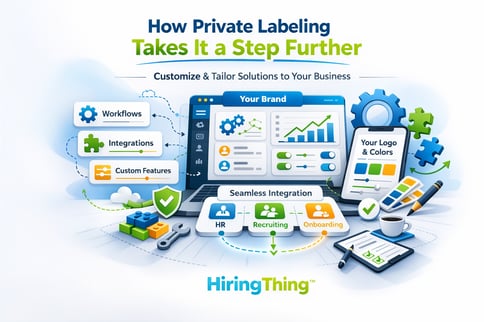
That can include adjustments to workflows, integrations, user experiences, and functionality that align more closely with the company’s business model. As a result, the solution does not just look like part of your company, it behaves like it was designed for it. That distinction matters in more specialized use cases where differentiation is key.
A helpful way to think about it is that all private labeling includes white labeling elements, but not all white labeling includes that level of customization. For SaaS companies that want more than branding alone, private labeling can be a stronger long term fit. That is part of why companies exploring recruiting solutions often look at partners like HiringThing, where customization and partnership depth can go beyond surface level branding.
Choosing the Right Partner Matters Most
Whether a company chooses white labeling or private labeling, success depends heavily on the partner behind the product. Technology matters, but alignment matters just as much, especially over time. The relationship becomes part of your business and part of how customers experience your brand.
The right partner should offer strong support, a reliable product, clear communication, and a genuine interest in helping your business succeed. This relationship is not just operational, it becomes part of your customer experience and brand promise. That is why many SaaS companies look to experienced providers like HiringThing when evaluating their options.
The Bottom Line
White labeling gives SaaS companies a smart and scalable way to grow without overextending their internal teams. It helps them offer more, move faster, strengthen customer relationships, and stay competitive in a changing market. That combination is difficult to ignore and increasingly common among growth focused SaaS organizations.
For many organizations, that makes it one of the most useful strategies available today. It is not about doing less work, it is about making better use of resources, partnerships, and timing. The result is often a more focused and effective approach to growth that aligns with real market conditions.
In a market that rewards speed, clarity, and consistent value, white labeling provides a path forward that aligns with how SaaS companies actually need to operate. It supports long term success without requiring every step to start from zero.

About HiringThing
HiringThing is a modern recruiting and employee onboarding platform as a service that creates seamless talent experiences. Our white label solutions and open API enable HR technology and service providers to offer hiring and onboarding to their clients. Approachable and adaptable, the HiringThing HR platform empowers anyone, anywhere to build their dream team.