
Virginia's pay transparency law took effect on July 1. Maine's followed on July 29. If you hire in either state, or recruit into them from an office somewhere else, the rules already changed on you. Here is what the two laws require, why Virginia is the one worth studying, and the one thing to fix in your postings today.
Summary
- Virginia requires a good faith wage or salary range in every public and internal posting, and there is no employer size threshold.
- Maine requires a prospective range of pay from employers with ten or more employees, plus pay history recordkeeping from everyone.
- Virginia also lets applicants sue directly. That is the provision most likely to show up in the next round of state laws.
- Remote roles get pulled in by where the work can be performed, not by where your headquarters sits.
If you posted a job in Virginia last month without a number in it, nothing broke and nobody warned you. That is the problem. Pay transparency laws do not throw an error. They just sit there quietly until someone notices, and in Virginia the someone who notices now has standing to do something about it.
Here is the plain version of what these two laws say, and what they tell you about the states that have not passed one yet.
What Virginia actually requires
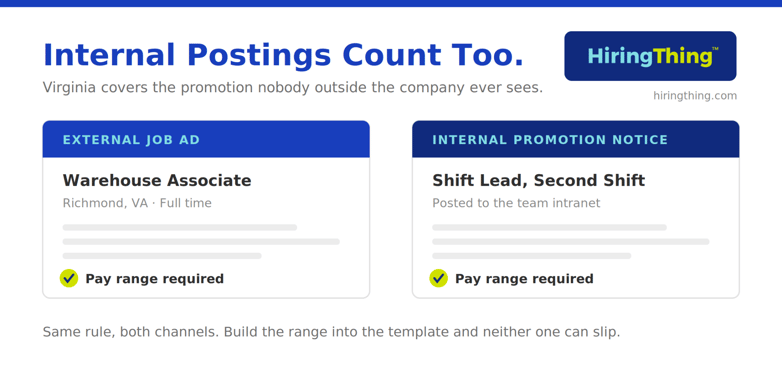
Virginia's Wage Transparency Act, added to the code as § 40.1-28.7:12, took effect on July 1, 2026. Every public and internal posting for a job, promotion, transfer, or other employment opportunity has to disclose the wage, the salary, or a range with a minimum and a maximum. The range has to be set in good faith.
Two details make this stricter than most people assume.
First, it applies to every employer in the Commonwealth. There is no headcount threshold, no revenue floor, and no exemptions for listings that were already live on June 30. A five person shop is covered exactly the way a five thousand person employer is.
Second, internal postings count. The promotion you announce on an intranet page or in a company wide email is a posting under this statute. So is the transfer opportunity you circulate to one department.
The salary history question is off the table
The same law bars employers from seeking an applicant's wage or salary history, from relying on it while considering someone, and from using it to set the pay they offer. That covers asking the applicant, asking a former employer, and asking a third party service to look it up for you. Virginia's Department of Labor and Industry published a short plain language summary of the change, which is worth forwarding to anyone on your team who conducts screens.
There is a narrow exception. If a candidate volunteers the number without being prompted, you may confirm it or rely on it to support a higher offer than the one you started with, as long as doing so does not create an unlawful pay gap. Read that as a one way valve. Volunteered history can move an offer up. It cannot be used to hold one down.
The law also protects candidates who ask. You cannot refuse to interview, hire, or promote someone because they asked what the role pays or declined to hand over their history.
What happens if you get it wrong
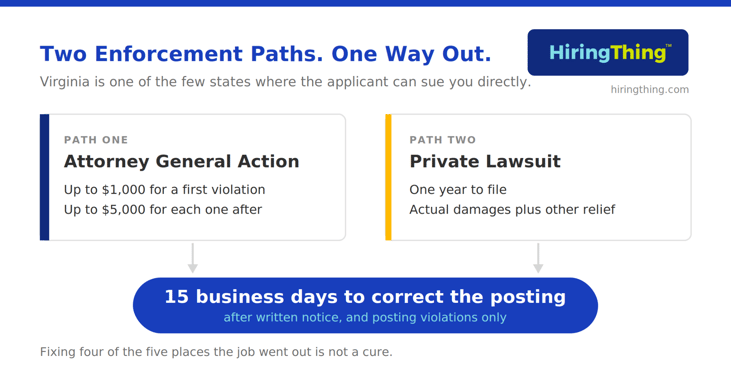
Enforcement runs on two tracks. The Attorney General can bring a civil action with penalties of up to $1,000 for a first violation and up to $5,000 for each one after that. Separately, an applicant or employee can sue on their own within a year and recover actual damages.
There is one piece of relief built in. For posting violations, an employer can avoid liability by correcting the posting within fifteen business days of written notice. That window is the reason distribution hygiene matters more than it used to. If the same req went out to your career page, two job boards, an aggregator, and a trade newsletter, fixing four of the five is not a cure.
Pay transparency was not the only thing that changed for Virginia employers that morning, either. A package of other hiring and employment rules landed on the same date, including new limits on enforcing non-competes against employees who are laid off without severance.
Maine drew the same line, then drew a threshold
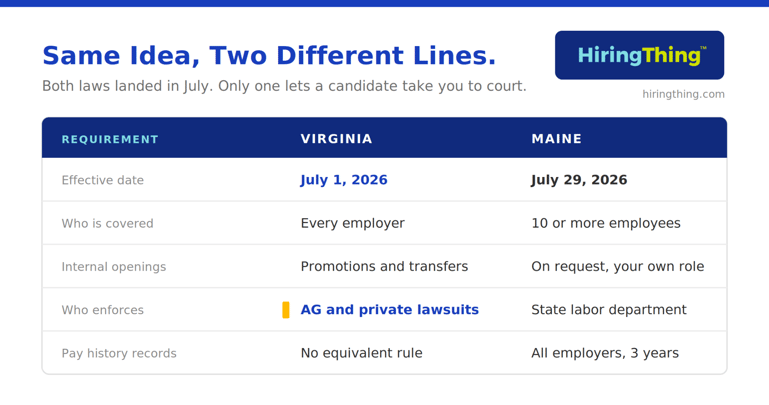
Maine's law took effect July 29 and covers employers with ten or more employees, who now have to include a prospective range of pay in any job posting, electronic or printed, whether the employer posts it directly or a third party does it on their behalf. Commission only roles are exempt from the range, but the posting has to say the pay is commission based.
Two other pieces of the Maine law are easy to miss. Current employees can ask for the range attached to the job they already hold, and the employer has to tell them. And the recordkeeping requirement, unlike the posting requirement, applies to every employer regardless of size. You have to keep a record of the positions each employee held and their pay in each one, for the length of their employment and for three years after they leave.
Enforcement is the other place the two states diverge. Maine's law does not expressly create a private right of action, and it instead funds a new inspector position at the state labor department to handle enforcement. Virginia handed part of the job to candidates.
Why Virginia is the version to plan around
There are now more than two dozen jurisdictions with some form of pay transparency requirement on the books, and the drafting has been drifting in a consistent direction. Virginia is the clearest snapshot of where it is heading.
No size threshold. Early laws carved out small employers. Virginia did not. Maine still has a ten employee line, which increasingly looks like the older design.
A private right of action. This is the big one. Most states left enforcement to a labor agency or an attorney general. Virginia handed it to applicants, which changes the math on a sloppy posting from a possible fine to possible litigation.
Internal opportunities in scope. Postings for promotions and transfers are treated the same as external ads. If your internal mobility process runs on email and a wiki page, that process is now regulated.
Third parties do not create a gap. Maine says so explicitly. Virginia's reach is broad enough that a recruiter posting on your behalf will not insulate you.
Tighter definitions of a range. California already narrowed what counts as a pay scale so that employers publish the range they actually expect to pay on hire rather than a career long span. Expect that framing to keep spreading. Delaware's law, already signed, does not take effect until late 2027, which gives you a preview of the next wave rather than a surprise.
If you hire across state lines, a current chart of who requires what is worth keeping bookmarked. The practical takeaway is simpler than the map, though. Build every posting to the strictest standard you are subject to and stop tracking it req by req.
What a defensible range looks like
Good faith is doing a lot of work in these statutes, and nobody publishes a maximum acceptable width. Ranges that survive scrutiny tend to have three things behind them.
- A documented method. A pay scale, a previously set range for the role, the actual range paid to people in equivalent positions, or the budgeted amount for the opening.
- A width that matches one job. A band wide enough to cover two pay grades is technically a range and practically an invitation.
- A written trail. If someone asks how you arrived at the number a year from now, the answer should not be a memory.
Where HiringThing makes this painless
Most of the pain in pay transparency is not legal. It is operational. The range is correct in one place and missing in three others, because the same job went to a career page, several job boards, and a recruiter's inbox on different days.
HiringThing is built so the job record is the single source of truth. You write the posting once, including the range, and the applicant tracking platform handles distribution to your career page and connected job boards from that one record. Update the range and the update travels with it, which is what turns a fifteen business day cure window from a scramble into an hour.
A few things worth setting up before your next req:
- Put the range in your job description template, not in the individual posting. Templates are how a requirement becomes a habit instead of a checklist item.
- Decide who can publish. Permissions keep a well meaning manager from posting a role without the number in it.
- Use separate sites for separate brands. Multi brand and franchise operations can run distinct career sites under one account, so a Virginia location's postings do not inherit a template built for a state with no requirement.
- Keep your internal openings in the same system. If promotions and transfers are posted through the ATS rather than over email, they inherit the same template and the same range.
Running hiring for other companies rather than for yourself? The same structure is what makes this manageable at scale. Partners who deliver hiring through a white label platform can standardize the posting template once and push a compliant default to every client, instead of fielding the same question from forty of them each time a state passes a law. Setup questions are documented in the support center.
What to do this right now
- Review every live posting for a role that can be performed in Virginia or Maine and confirm each one shows a range.
- Check the internal ones too. Promotions and transfers count in Virginia.
- Write down the method behind your ranges, even in a shared doc, so good faith is something you can show rather than assert.
- Tell anyone who screens candidates that the salary history question is gone, including the softer versions of it.
The laws will keep arriving, roughly two or three states a year at the current pace. The work of hiring did not change. Build the range into the template once and the next state's law becomes a footnote instead of a fire drill.
About HiringThing
HiringThing is a modern recruiting and employee onboarding platform as a service that creates seamless talent experiences. Our white label solutions and open API enable HR technology businesses to offer hiring and onboarding to their clients. Approachable and adaptable, the platform empowers anyone, anywhere to build their dream team.