


-
Back in January we published our take on where vertical software was headed this year. Predictions are easy to write in January. They are much harder to look at again in August after several quarters of results.
Summary
- Vertical software crossed the halfway mark of software M&A, reaching about 54 percent of second quarter deal activity against 46 percent a year earlier, though buyers now pay premiums only for regulatory depth and proprietary workflow data.
- Embedded finance outgrew the subscription at the category leaders, with one restaurant platform earning roughly $5 billion from financial technology against $936 million from software, and less than a fifth of the $185 billion opportunity captured.
- Agent ambition badly outran agent delivery, with 78 percent of enterprises running pilots and only 14 percent scaled to organization wide use, while industry specific agents outperform general copilots by three to five times on task completion.
- Seat based pricing collapsed faster than forecast, falling from 21 percent to 15 percent of software companies in twelve months as hybrid models climbed to 41 percent, even though 94 percent of executives say seats still match the value they deliver today.
So that is what we are doing here. The first half of 2026 is closed, the second quarter numbers are in, and there is now enough evidence to grade the work instead of guessing at it. Some of what we called has moved faster than we expected. One item we were confident about is still stuck in the demo phase. And one trend that seemed inevitable six months ago quietly slid down the priority list.

If you build, sell, or buy industry specific software, the midyear picture matters more than the January one. Budgets are being reset right now for the fourth quarter and for next year. Here is what the first half actually proved.
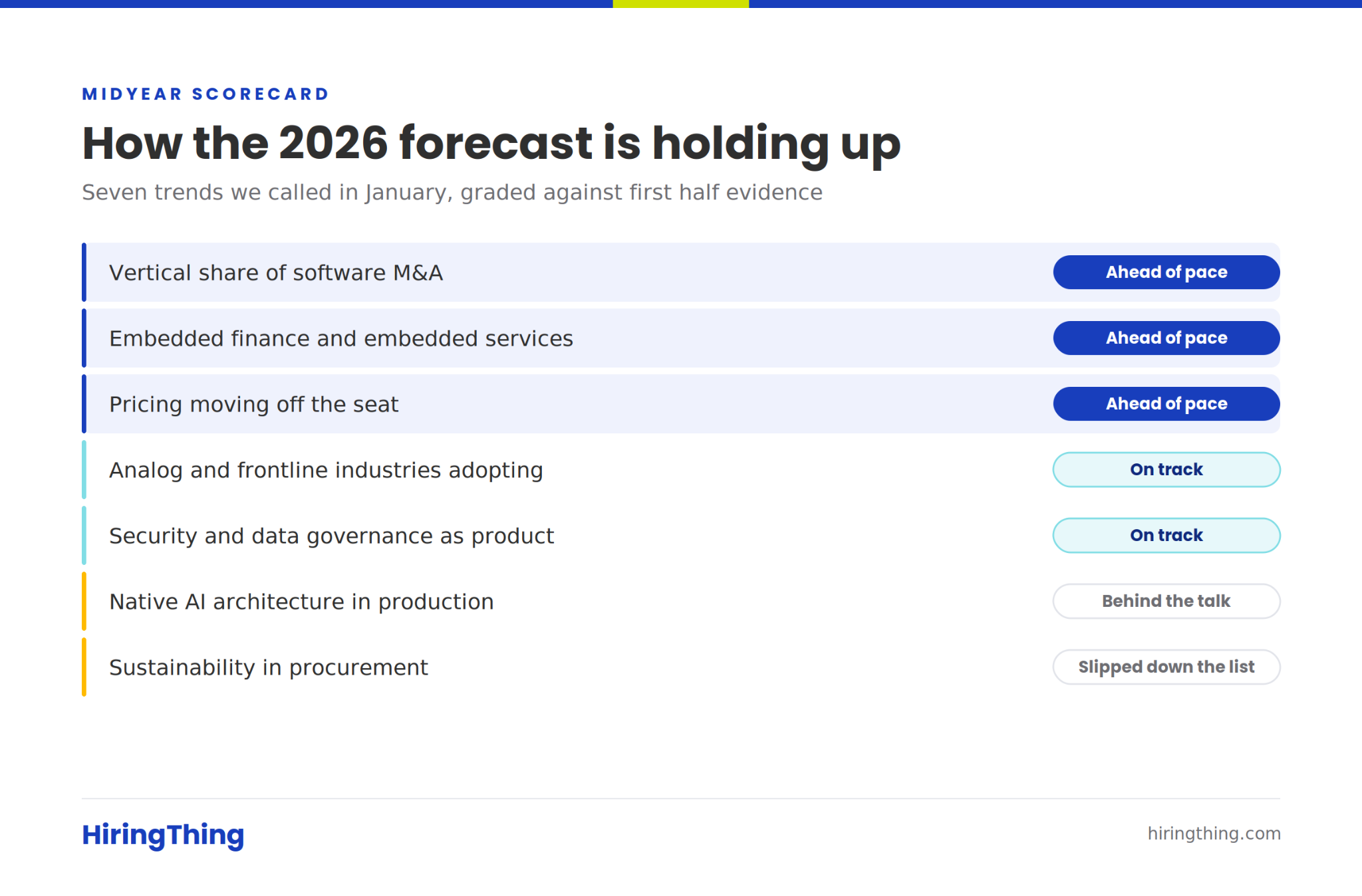 Our own January list, graded against first half evidence. Three trends outran the forecast, two are on pace, and two are behind the conversation.
Vertical Software Is No Longer a Slice of the M&A Market. It Is the Market.
We said vertical vendors would become the acquirers rather than the acquired. That call was right, and it was conservative.
Vertical software accounted for roughly 54% of second quarter software deal activity this year, up from about 46% in the same quarter last year, according to a quarterly transaction tracker that follows the software market. Total volume held up too, with 698 deals announced in the quarter, a rise of close to 10% y/y. When a category crosses half of all deal activity, it stops being a segment and becomes the default.
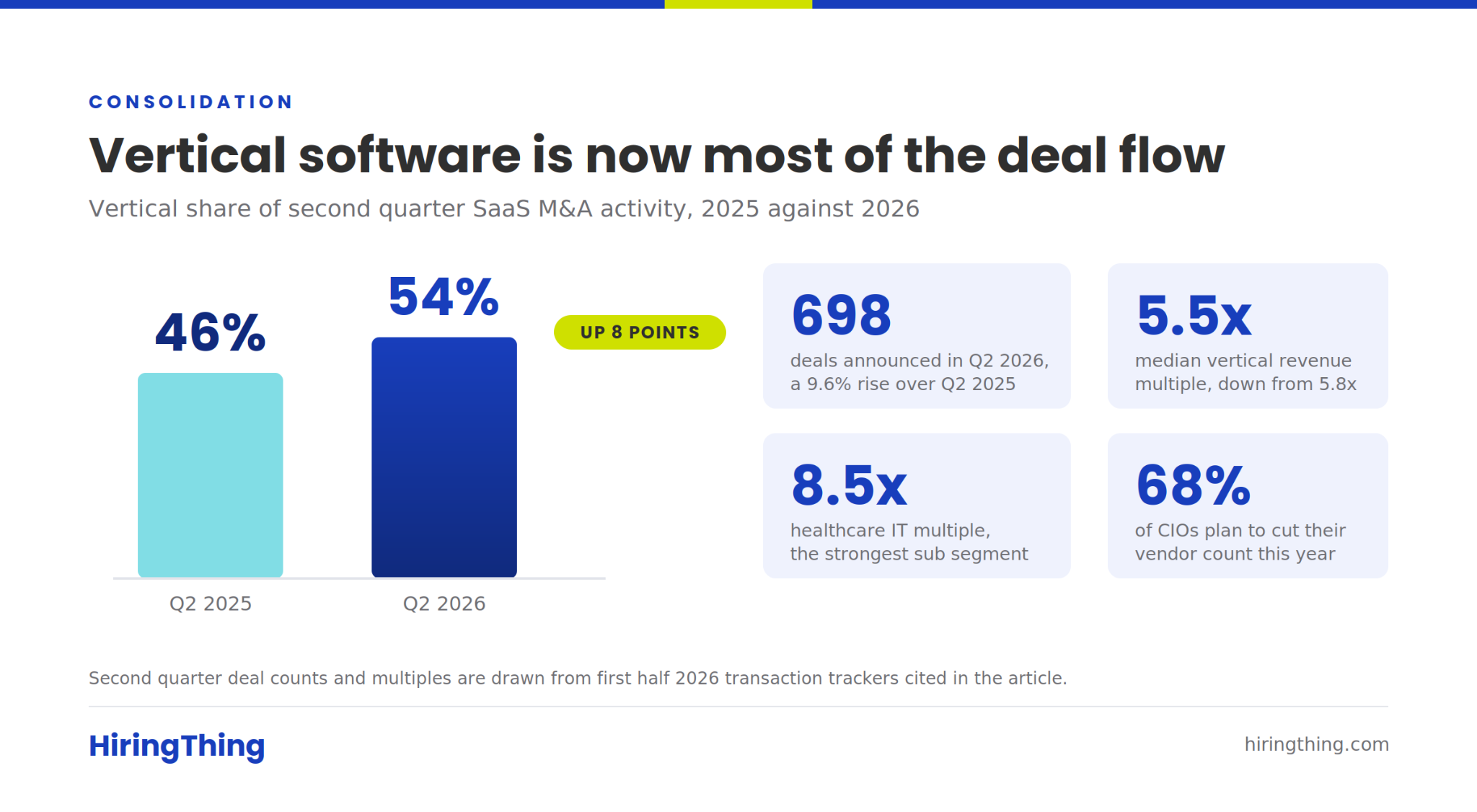
Vertical software crossed the halfway mark of software deal activity in the second quarter of 2026.
What is more interesting is what buyers are paying for. Multiples came down across the board, but the spread between sub segments widened.
Here is roughly where one vertical software deal report puts them:
- Healthcare IT: near 8.5x revenue. The strongest sub segment in the category, built on regulatory barriers and embedded payment volume.
- Legal technology: near 7x. Anchored by practice management platforms that own the full client workflow.
- Vertical software overall: near 5.5x so far this year, down from 5.8x last year.
- Education technology: well behind both leaders, at roughly half the healthcare multiple.

That spread is the whole story. Buyers are not paying a premium for the word vertical. They are paying for regulatory complexity, proprietary workflow data, and a system of record that is genuinely difficult to rip out. Anything less than that is priced like ordinary software.
Two other forces are feeding this:
- Customers are cutting vendors
Roughly two thirds of corporate technology leaders plan consolidation this year, according to an analysis of the current consolidation wave. Fewer vendors per customer means the survivors absorb the workflows the losers used to hold. - Public and private valuations came apart
Public software valuations fell hard in the first half while private processes stayed competitive, a gap advisors running sell side deals attribute to the lag between public sentiment and negotiated private pricing.
For a platform serving a single industry, that combination is an opportunity. Your customers want fewer vendors. Your adjacent competitors are cheaper than they were a year ago. A midyear technology deal review makes the same point from the seller's side, noting that acquisition has become the primary exit path while public listings stay selective.
This is also the practical case for adding capability through partnership rather than acquisition. If your industry needs hiring and onboarding but you have no interest in building or buying an HR product, embedding a white label applicant tracking system closes the gap in a quarter instead of a fiscal year. We wrote about how those partnerships actually generate revenue if you want the arithmetic.
The Money Layer Grew Faster Than the Software Layer
We said embedded finance and embedded services had moved from experiment to expectation. The first half data suggests we understated it.
Look at what the public filings show. According to a study of filings across the category:
- A restaurant platform reported around $5 billion in financial technology revenue last year, against $936 million in subscription revenue. The payments business is more than five times the software business.
- A commerce platform now draws roughly 73 percent of total revenue from merchant solutions rather than software fees.
- A fitness and wellness platform pulls more than half of its revenue from financial products.
These are companies that started as software businesses and became financial services businesses by revenue mix.
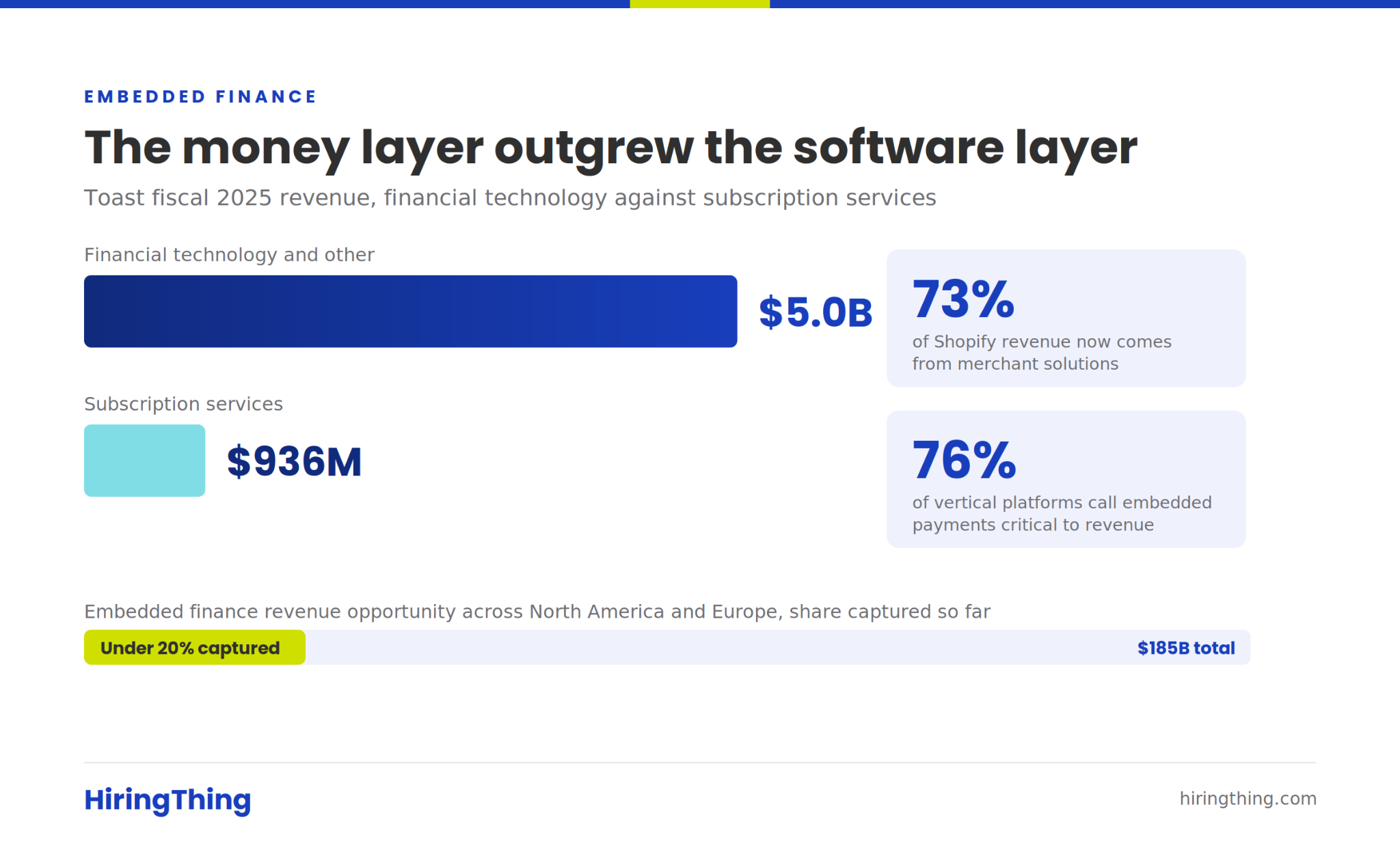
When the payments layer earns five times what the software layer earns, the subscription is the customer acquisition channel.
The operators agree. In a first quarter benchmarking study of vertical platforms, roughly three quarters of respondents described embedded payments as very important or a critical revenue driver. This is no longer a strategy debate. It is an execution and attach rate problem.
And most of it is still unclaimed:
- Roughly $185 billion in addressable embedded finance revenue across North America and Europe, with less than a fifth captured, per a market map of the opportunity.
- The widest gaps sit in lending, banking, and financial management, not in payments, which is the most crowded entry point.
- Two to five times higher revenue per customer is the range one analysis of platform unit economics attributes to adding financial products.
The sequence that keeps working is the same one we described in January, and the order matters because each step produces the data the next step requires:
- Payments first: This is where the transaction history comes from.
- Lending second: The transaction history is what makes underwriting possible.
- Insurance and banking third: Both depend on knowing the customer's real operating volume.
- Payroll alongside the rest: This is primarily a retention play rather than a margin play.
That ordering is exactly why a horizontal platform cannot run the same play at the same depth. It does not own the operational data that step two requires.
Here is the part that gets missed in HR and workforce software. Payroll and hiring sit on the same side of that data flywheel. If your platform already knows who was hired, when they started, what they are paid, and whether they stayed, you are holding the inputs for financial products, workforce analytics, and compliance monitoring at the same time. That is why we treat employee onboarding as infrastructure rather than a feature.

Agents Are Everywhere in the Deck and Nowhere in Production
This is the one where the market talked much bigger than it shipped.
We predicted a widening split between AI enabled products and genuinely AI native architecture. That split is real, but the honest first half finding is that very few companies are on the native side of it yet. In a March survey of 650 enterprise technology leaders, 78 percent had at least one agent pilot running while only 14 percent had scaled an agent to organization wide operational use.
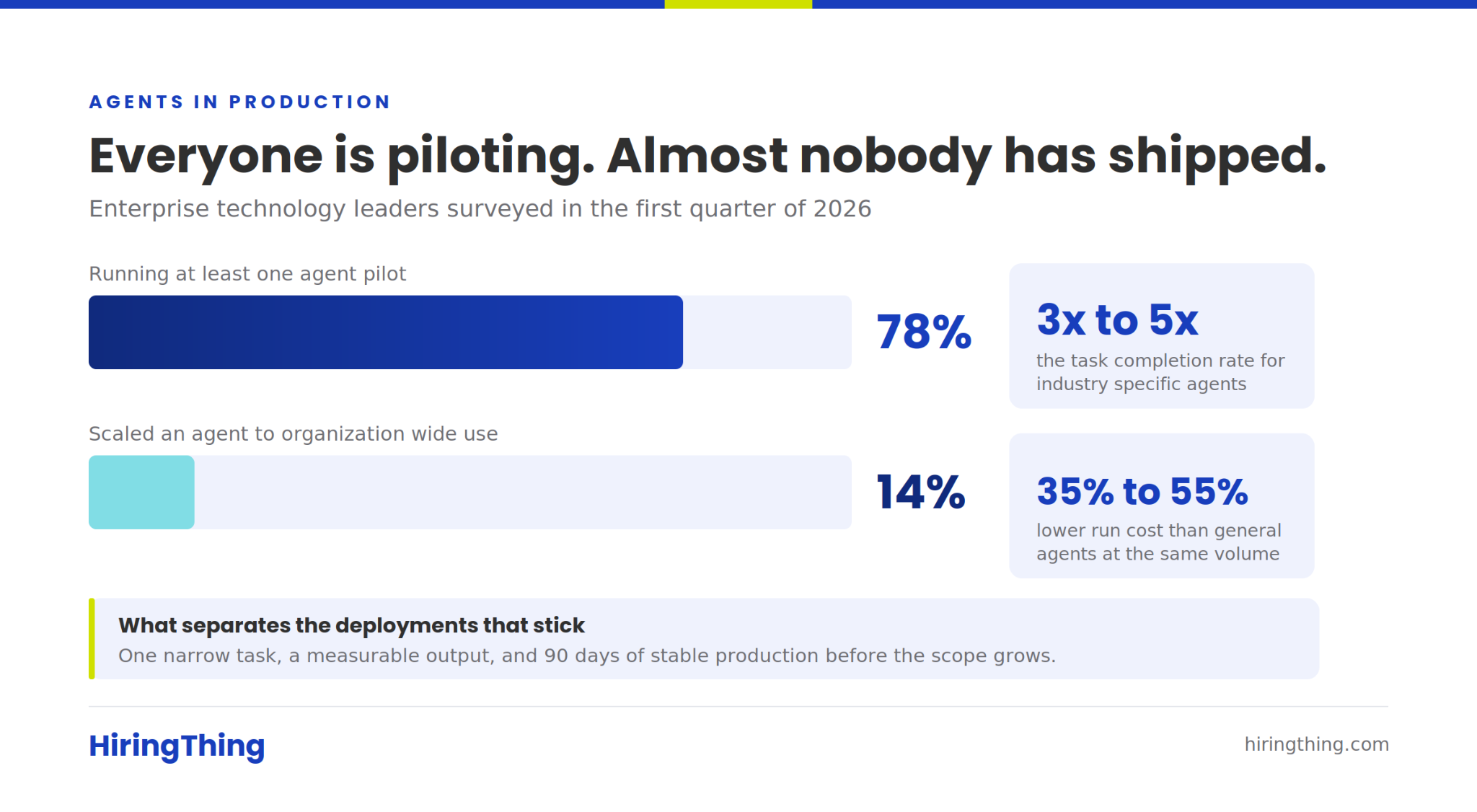
The gap between running a pilot and running production is the defining operational problem of this year.
You have probably seen the claim that 88% of agent pilots never reach production. Treat that number carefully. One implementation guide tried to trace it to a primary source and could not, and reported production rates across other surveys this year range from the low teens to above 50% depending on who was asked and what counted as production. The direction is consistent even when the precision is not. Pilots are cheap and plentiful. Production is neither.
What is failing is rarely the model. It is scoping, evaluation, data access, and ownership.
The deployments that survive tend to share four things:
- One narrow task, not an open ended assistant.
- A measurable output that someone agreed to measure before the build started.
- Roughly 90 days of stable production before anyone expands the scope.
- A named owner who can shut it off.
The good news for industry specific platforms is substantial.
A practitioner guide to vertical agents reports two findings worth putting in front of a product team
- Industry specific agents complete tasks at three to five times the rate of general purpose copilots.
- They run 35 to 55% cheaper at comparable volume, and the cost gap widens as volume grows.
The explanation is unglamorous. Generic agents handle the roughly 60% of a workflow that looks like every other workflow, then break the moment they touch something regulated, integrated, or financially material. Meanwhile a review of agent deployment patterns notes analyst expectations that around 40% of enterprise applications will include task specific agents by the end of this year, up from under 5% last year.
For recruiting and onboarding, the narrow wins are obvious and unglamorous:
- Screening against defined, documented criteria
- Interview scheduling and rescheduling
- Document collection and completion chasing
- Credential and license expiration monitoring
- Compliance checks that run continuously instead of quarterly
That is also the argument for building on top of a documented API rather than a black box, which is why we keep our developer documentation public.

Pricing Moved Faster Than We Expected
In January we described the shift away from seat based pricing as a trend. Six months later it looks more like a stampede.
The first half numbers:
- Pure per seat pricing fell from about 21% to 15% of software companies in twelve months, per pricing model tracking published this year.
- Hybrid models climbed from roughly 27% to 41% over the same period, combining a base fee with usage or outcome components.
- Hybrid adoption is projected near 61% by year end, up from 43%, according to a pricing strategy guide from this spring.
- Vendors charging on verified results report meaningfully better retention than those charging for access.
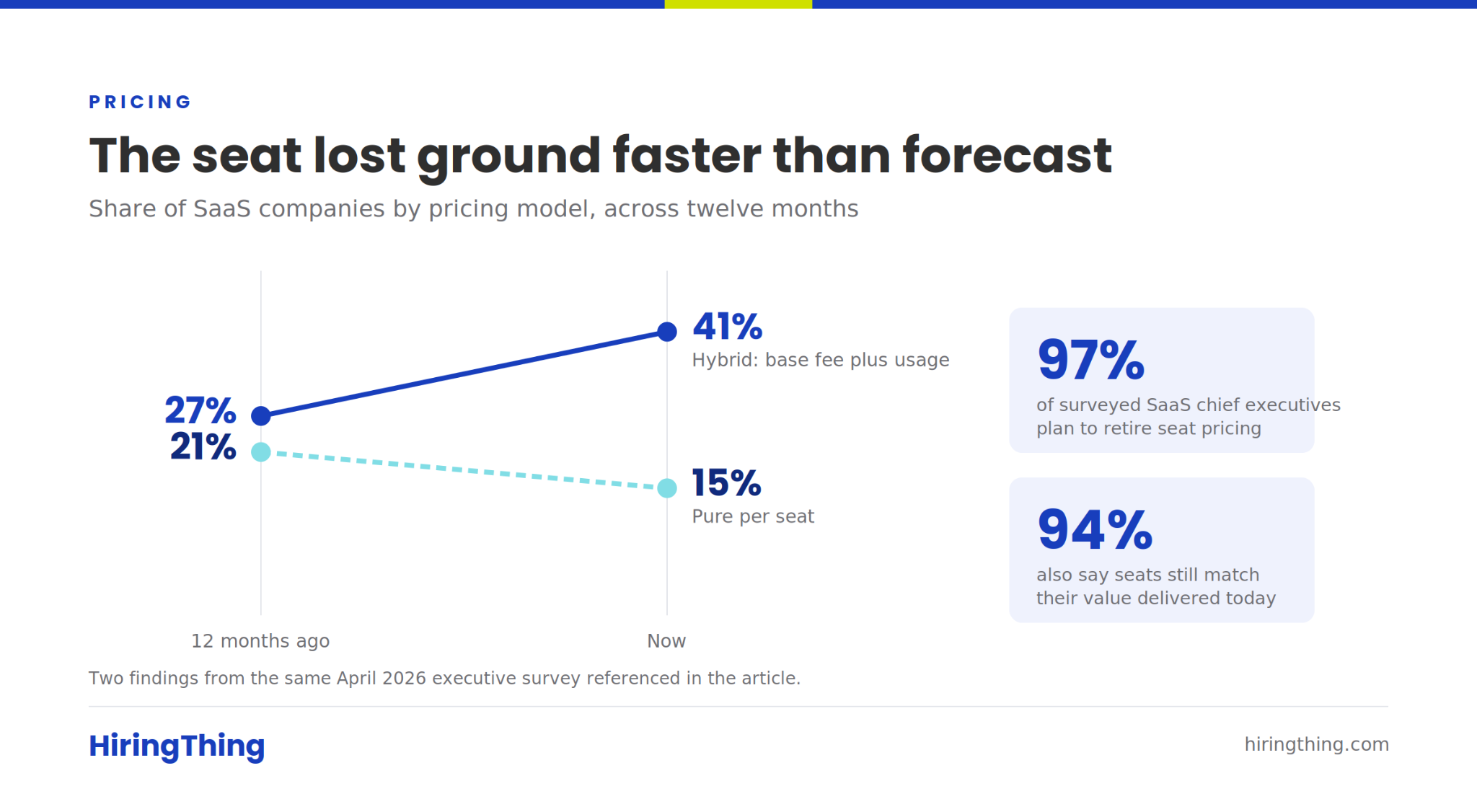
Twelve months of movement in software pricing models. The destination is contested. The direction is not.
The most revealing data point of the first half came from an April survey of 300 software chief executives, which produced two findings that sit awkwardly together:
- 97% plan to retire seat based pricing within two years.
- 94% say seat based pricing currently aligns with the value their product delivers.
Read those together and you have the real state of pricing in 2026. Almost everyone believes the seat is finished. Almost nobody has found a replacement that survives contact with a procurement team. Hybrid is not a philosophy, it is a landing zone, and analyst forecasts on enterprise software spending suggest the transition runs well past this decade's midpoint before it settles.
There is a hard requirement buried in this.
Outcome pricing only works when all three of the following are true:
- The outcome is technically verifiable in your own system.
- The outcome is cleanly attributable to your product rather than to five other things.
- Both sides agree on what counts as success before the contract is signed.
If you cannot satisfy all three, usage based billing is the honest answer and outcome language is marketing. In hiring technology the defensible units are hires completed, placements filled, onboarding packets finished, and credentials verified. Logins are not a unit of value. They never really were.
The Analog Industries Finally Started Spending
We said the fastest growth would come from industries still running on spreadsheets, shared drives, and clipboards.
That held, and the structural gap behind it is still remarkable:
- Roughly 80% of the global workforce works away from a desk, while historically only about 1% of enterprise software spending was built for those workers, a mismatch documented in a buyers guide for deskless workforce tools.
- Frontline workforce software is tracking from roughly $13.5 billion last year toward $30.7 billion by 2031.
- The United States frontline technology market is on a similar path, from about $4.1 billion to $11.4 billion over the same window, per a comparison of frontline platforms.
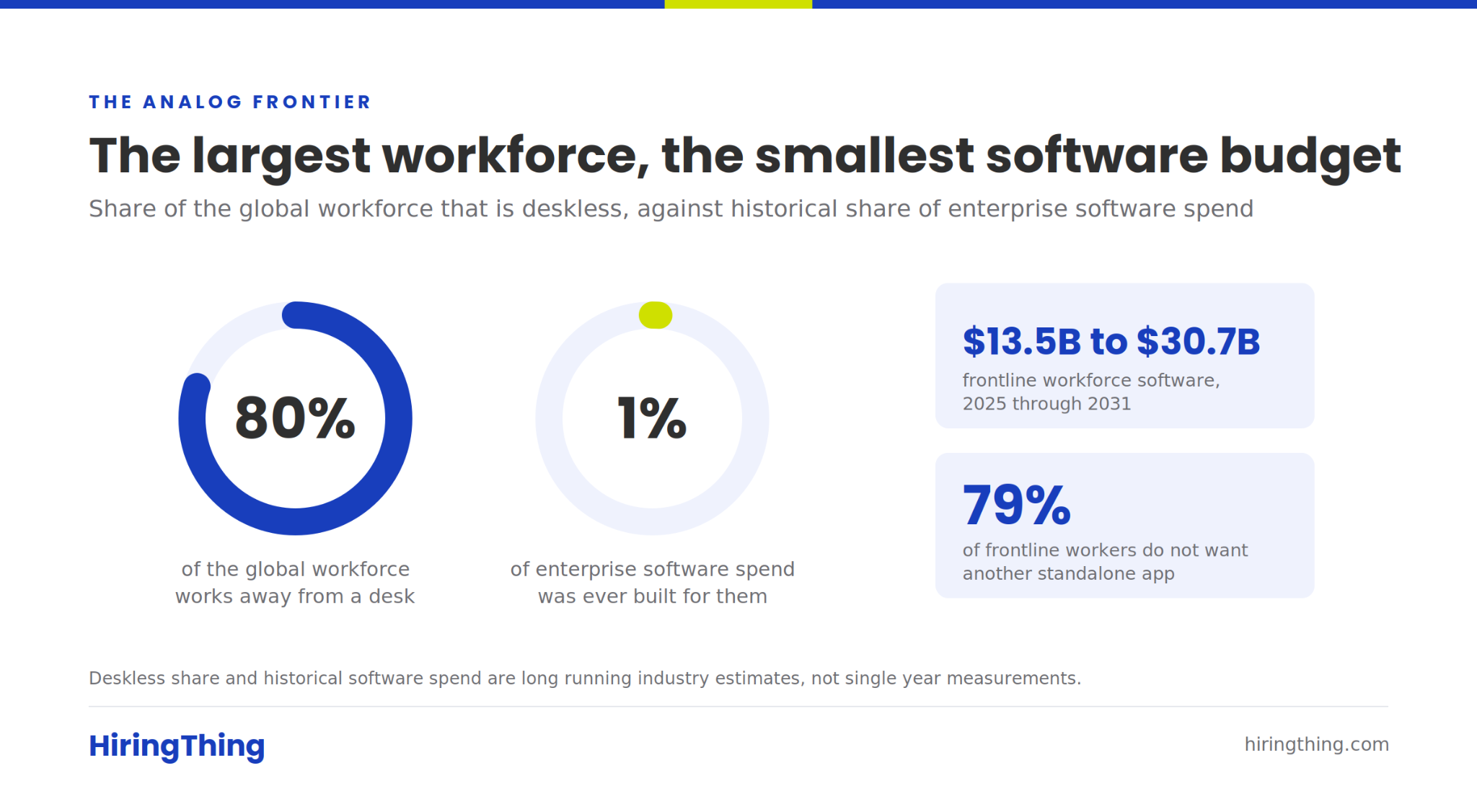
The largest workforce in the world has historically received the smallest share of software investment. That is the arbitrage. Growth alone is not the lesson.
Adoption is where these deployments live or die, and research on frontline technology adoption points at two specific failure points:
- About half of frontline leaders name complicated access as the single biggest barrier to adoption.
- Close to four in five frontline workers would rather not install yet another standalone app.
That is a design constraint with teeth. If a new hire in construction, home health, or food service cannot finish onboarding from a personal phone, without a corporate email address and without downloading anything, the workflow does not get adopted no matter how good the back end is. We built construction focused hiring and onboarding around that constraint rather than around the org chart.
Where We Were Early, and Where We Were Wrong
Three entries on our January list deserve revisiting.
-
Sustainability and ESG in procurement has not accelerated the way we suggested it would
It has not disappeared from enterprise and public sector questionnaires, but in the first half it was crowded out by AI governance, model transparency, and data residency questions. Buyers are still asking about compute and energy, just further down the document and with less weight attached. We were early on that one, and possibly early by more than a year. -
Customer support as the ultimate differentiator held up, but the definition shifted underneath it
In last year's edition and again in January we framed support as domain fluent humans plus automation. What the first half showed is that the differentiator is now process consulting. Customers deploying agents inside regulated workflows do not need help configuring software. They need help deciding which steps a machine should own, which steps a person must sign off on, and what the audit trail has to prove. That is a materially harder service to staff, and it is closer to what we describe in partner experience than to a traditional help desk. -
Trust and security as core product is simply on track
It is now table stakes rather than a differentiator. Encryption, zero trust identity, and continuous audit trails get you into the evaluation. They no longer win it. Our own approach is documented on our security page for anyone comparing notes.
What the Second Half Looks Like From Here
Four things we expect between now and January, offered with the same willingness to be graded later.
- Consolidation continues but gets pickier
Deal volume stays elevated while the gap widens between platforms with defensible data and platforms with a nice interface. Multiple compression continues for the second group. - The production gap becomes the story
Buyers stop asking vendors whether they have AI and start asking how many agents are running in production, on what workflows, with what error rate. Vendors who cannot answer with specifics lose deals to vendors who can. - Hybrid pricing becomes the standard rather than the experiment
Expect more base fee plus consumption contracts, more per unit pricing tied to industry specific events, and considerably more argument about what counts as a verified outcome. - Frontline and deskless workflows attract more capital than headquarters software
The spending gap is too large and the mobile requirement too well understood to stay unfunded.
Summing Up - We Were Right
Vertical software spent the first half of 2026 proving the thesis rather than debating it:
- It is now most of the software deal flow.
- Its best operators earn more from the money layer than the software layer.
- Its pricing is coming off the seat faster than anyone forecast.
- Its biggest remaining opportunity is the workforce that has never had software built for it.
- Its agent story is still mostly a pilot story.
The gap between the vendors who will own their industries and the vendors who will get consolidated into someone else's platform comes down to the same three things it did in January: depth in one industry, workflows customers cannot easily unplug, and honesty about what your AI actually does in production. The challenges we mapped earlier have not changed. The clock has just moved faster than usual.
If you are working through where hiring and onboarding fit into your platform roadmap, that is the conversation we have every day, and there is more background on how ATS integration pays off for vertical platforms.
About HiringThing
HiringThing is a modern recruiting and employee onboarding platform as a service that creates seamless talent experiences. Our white label solutions and open API enable HR technology businesses to offer hiring and onboarding to their clients. Approachable and adaptable, the platform empowers anyone, anywhere to build their dream team.

.jpg?width=45&name=1621426681866%20(1).jpg)
