.jpg?width=45&name=1621426681866%20(1).jpg)

By using white label HR software you immediately expand your product offerings. White labeling SaaS solutions entails using another vendor's software and rebranding it as your own. Companies white label new solutions to offer new functionalities and services without getting mired in the development process.
Summary
- White labeling HR software lets companies expand their catalog without funding a build.
- HR tech spending reached $47.51 billion in 2026, and buyers are actively consolidating vendors.
- Multiproduct platforms are growing revenue 49% faster than software-only peers, which makes a white labeled module one of the cheapest growth levers available.
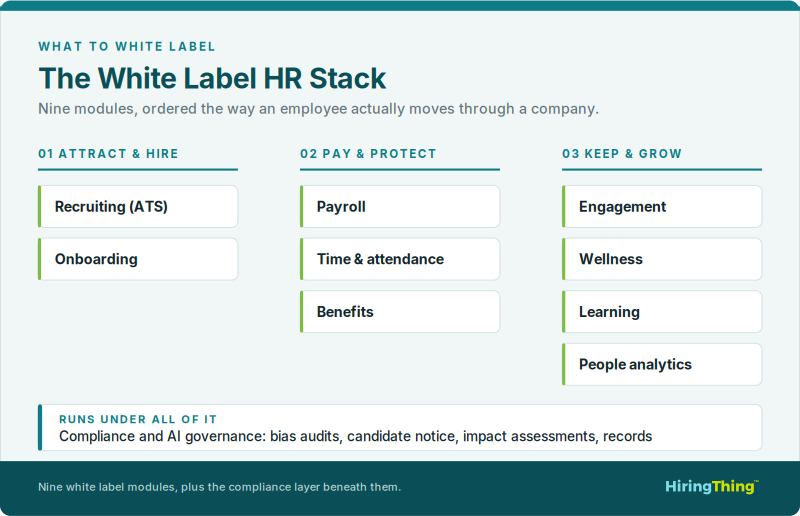
- Key areas for white label HR software in 2026 include recruiting, onboarding, payroll, timekeeping, benefits, wellness, engagement, learning, people analytics, and compliance.
- AI governance has quietly become a buying requirement rather than a differentiator.
Make Your SaaS Company More Competitive
- White Label HR Software Keeps Companies Competitive
- The Top HR Software Solutions to White Label
- How to Establish a White Label HR Partnership
White labeling helps businesses keep up with the demands of today's customers, who want solutions that solve more than one problem and who expect consistent product evolution. One of the most significant benefits of white labeling is that new functions and features are available almost immediately, allowing purchasers to start growing their revenue, expanding into new markets, and becoming instantly more competitive.
White Label HR Software Keeps Companies Competitive
HR software is still having a moment, and the moment got expensive. Mordor Intelligence puts the global HR tech market at $47.51 billion in 2026, up from $42.34 billion in 2025 and tracking toward $77.74 billion by 2031. The Josh Bersin Company found that a large company now spends roughly $310 per employee per year on HR systems, a 29% jump in a single year, and runs at least nine of them at once.
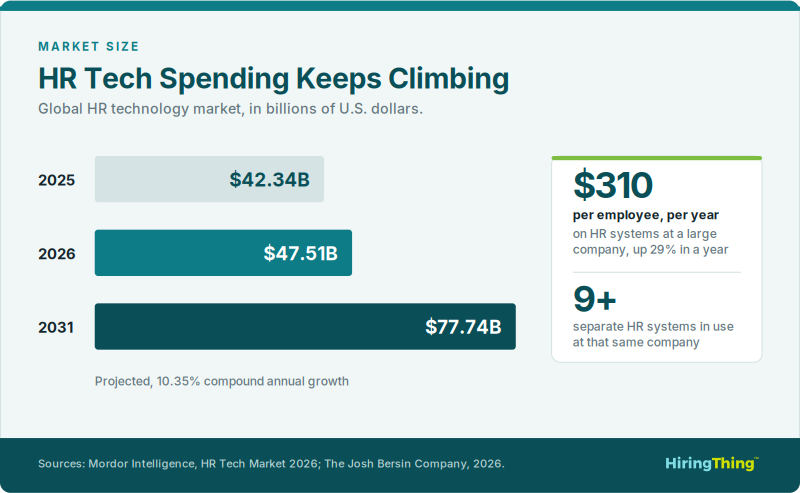
Nine systems is the whole opportunity in one number. Every one of those nine is a vendor your customer has to buy, integrate, train on, and renew. Buyers have run out of patience for that, and consolidation is now the default posture.
The other thing that changed is AI. In 2026, HR tech stopped shipping copilots and started shipping agents. Bersin's HR 2030 research projects that HR departments will shrink 30% to 50% by 2030 as agentic systems absorb administrative work, and SHRM found that 51% of organizations already use AI somewhere in recruiting, making it the most common HR application of the technology. If your platform has no AI story across the employee lifecycle, your renewal conversations are about to get harder.
White Labeling Helps HR Technology Companies Offer All-In-One Solutions
The market has settled the build versus buy debate with numbers. Stripe's 2026 vertical SaaS data shows that platforms running a multiproduct strategy grow revenue 49% faster than software-only peers, and platforms with embedded financial products churn 11% less annually. Across SaaS more broadly, multiproduct companies are growing about 21% faster than single-product peers, and 59% of vertical SaaS companies have already crossed into multiproduct territory.
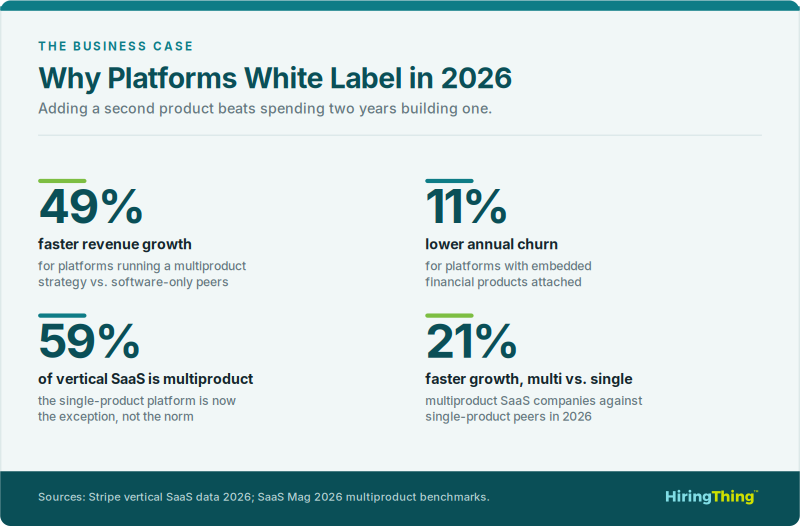
Read that last one again. If you are still a single-product platform, you are the minority now, and the majority is compounding faster than you are. Forward-thinking HR systems white label additional software to stay competitive, get stickier, and give customers what they are already asking for. Vertical SaaS providers do the same thing to add HR software to their platforms, layering in additional functionality and proving they understand every corner of their niche.
Dominate Your Niche With White Label Software
HR is a big industry, and there are more HR tech options than ever (Bersin's latest count runs past 3,800 vendors). Choosing what to add can be paralyzing, which is why we did the sorting for you. Below you'll find the categories worth white labeling in 2026, what buyers want from each, and where the revenue actually is.
The Top HR Software Solutions to White Label
Recruiting (Applicant Tracking System)
Recruiting is still where the money goes, so it belongs at the top of your list. Jobscan's most recent audit detected an applicant tracking system at 97.8% of Fortune 500 companies, 489 out of 500. Roughly 75% of recruiters work inside one daily, and 94% say their ATS has improved their hiring. Adoption at the top of the market is effectively total. Adoption among small and mid-market employers is not, and that gap is exactly where a white labeled ATS finds customers.
Why You Should White Label an Applicant Tracking System
The ATS market sits at $3.17 billion in 2026 and is tracking toward $4.33 billion by 2030. More persuasive than the market size is the pain. NFIB's July 2026 jobs report found that 36% of small business owners had openings they could not fill, well above the 24% long-run average, and 51% reported few or no qualified applicants.
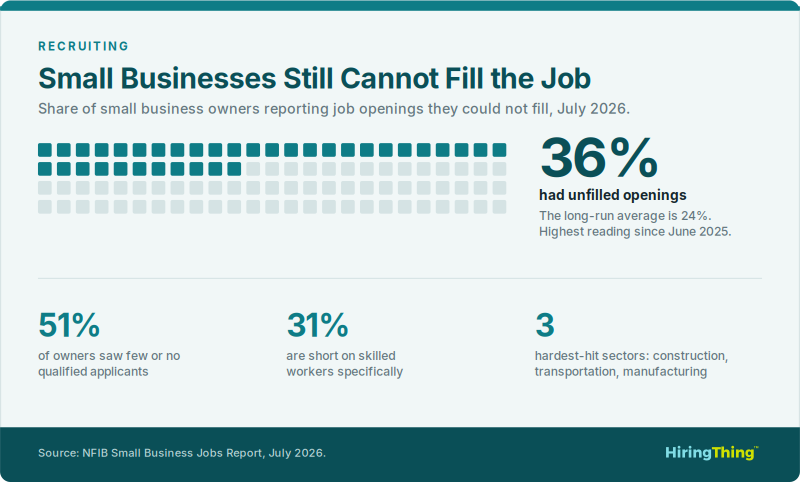
HiringThing Pro Tip: NFIB refreshes those numbers every month, which makes them excellent, always-current sales collateral for a white labeled recruiting solution.
Onboarding
Employee onboarding software gets new hires productive, tracks progress against goals, and keeps managers honest about the handoff. Brandon Hall Group's research is the figure everyone cites: strong onboarding improves new hire retention by 82% and productivity by more than 70%. Gallup's finding is the one that should interest you commercially. Only 12% of employees say their company onboards well.
Why You Should White Label Onboarding Software
That 12% is an 88% addressable market. Nearly 30% of employees leave within their first 90 days, 20% of all turnover happens inside the first 45 days, and companies that automate onboarding see 16% better new hire retention and an 18% lift in new hire performance. Your customers are losing people to a problem software already solves, and most of them have not bought the software yet.
Payroll
Payroll software tracks wage and salary rates, runs pay periods, calculates withholding, and moves the money. Competitive products bundle time tracking, tax management, and reporting. Getting it right is not a back-office nicety. It is the most visible promise an employer makes, twice a month, forever.
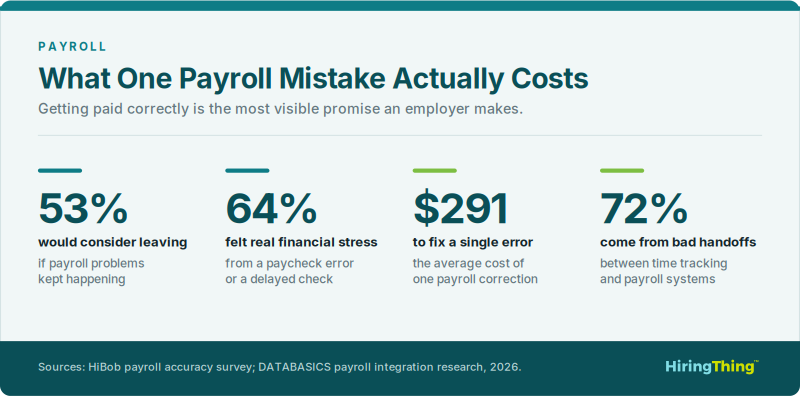
HiBob's survey of 2,000 US employees found that 64% have felt real financial stress from a paycheck error or delay, and 53% would consider leaving if the problems kept happening. Each individual error costs about $291 to correct, and roughly 72% of them trace back to time tracking and payroll systems that do not talk to each other.
Why You Should White Label Payroll Software
The HR payroll software market reached $42.78 billion in 2026 and is headed toward $62.64 billion by 2030. Embedded payroll is the version of that story that matters to platforms. Pricing typically runs a base fee of $35 to $70 per customer per month plus $6 to $10 per employee per month, with the platform keeping about two thirds. A vertical SaaS platform with 1,000 payroll customers averaging 20 employees each can realistically build a $1 million to $3 million annual revenue line. Every employer pays people, so payroll travels into any vertical you serve.
Benefits Software
Benefits administration is under more pressure than at any point in fifteen years. Mercer's survey of more than 1,700 US employers projects total health benefit cost per employee rising 6.5% in 2026, the steepest jump since 2010, pushing the average past $18,500 per employee. Business Group on Health members put their median trend at 9% before plan design changes.
Why You Should White Label Benefits Software
When costs climb that fast, employers stop tolerating manual enrollment and spreadsheet reconciliation. Benefits software absorbs the administrative load, surfaces the cost data leaders need to make plan decisions, and gives employees a self-service experience that makes an expensive benefit feel worth the money. Wellness and benefits administration is also the fastest-growing application segment in HR tech, compounding at 12.34% through 2031.
Mental Health and Wellness
Behavioral health moved from perk to line item. Business Group on Health found that 73% of employers saw an increase in mental health and substance use service utilization, with another 17% expecting one. About two thirds of large employers named better access to behavioral care a top priority, ranking it directly behind cost control.
Why You Should White Label Wellness Software
Gallup's 2026 data explains the demand. Among workers globally, 40% report daily stress, 23% sadness, 22% anger, and 22% loneliness. Employers understand they cannot cost-manage their way out of that. Wellness SaaS covers everything from mindfulness and meditation to therapy access and manager training, and it attaches cleanly to a benefits module you may already be selling.
Employee Engagement
New white labeled solutions work best when they solve a problem your customers already lose sleep over. Engagement qualifies.
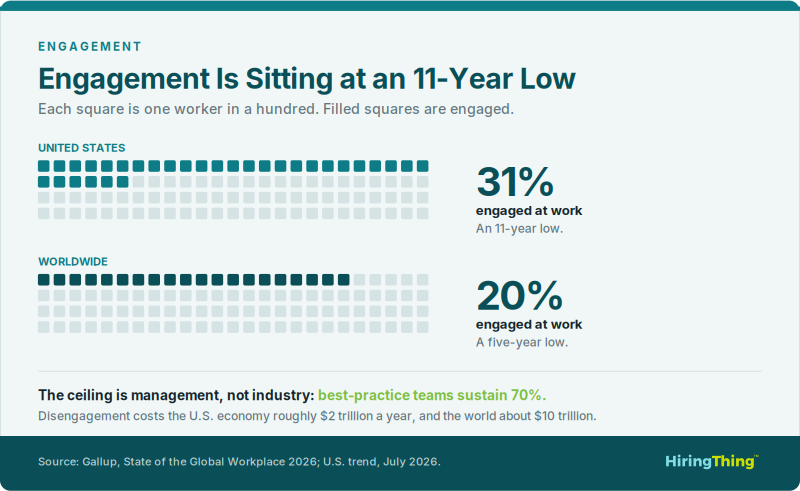
Gallup put US engagement at 31% through the first half of 2026, an 11-year low, and global engagement at 20%. Disengagement costs the US economy an estimated $2 trillion a year and the global economy roughly $10 trillion. The encouraging part, if you sell software for a living, is that best-practice organizations sustain 70% engagement in every sector. The ceiling is management practice, not industry.
Why You Should White Label Engagement Software
Engagement software collects formal and informal feedback at regular intervals, standardizes the review process, and runs recognition and reward programs. Gallup's meta-analysis links top-quartile engaged teams to a 78% swing in absenteeism and a 51% swing in turnover. Those land in EBITDA, not in a culture deck, which makes engagement one of the easier modules to put a price on.
Learning and Development
A lack of professional development is still a top reason people leave, and the skills math has gotten urgent. The World Economic Forum expects 39% of workers' core skills to change by 2030, and 59% of the global workforce to need reskilling or upskilling. Some 63% of employers call skills gaps the single biggest barrier to business transformation.
Why You Should White Label Learning Solutions
US organizations spent $102.8 billion on training in 2025, about $874 per learner. The delivery layer is growing faster than the spend: Grand View Research values the learning management system market at roughly $34.1 billion in 2026, compounding above 20% annually. Only about a third of organizations run learning programs mature enough to keep pace with how fast skills are shifting, which is a polite way of saying most of your customers need better tooling.
Timekeeping and Attendance
Timekeeping and attendance software tracks working hours for salaried and hourly employees, oversees scheduling, manages time off and overtime, and feeds payroll clean data.
Why You Should White Label Timekeeping and Attendance Software
Refer back to that 72% figure. Most payroll errors are timekeeping errors wearing a disguise. Integrating time tracking with payroll cuts errors by roughly 80%, and about 20% of payrolls still contain at least one error today. For customers running shift work in construction, healthcare, hospitality, or field services, this module frequently sells itself before the ATS does.
People Analytics
HR analytics software helps companies make data-driven decisions across the full breadth of the HR cycle. In 2026 the most valuable version of that is workforce planning against AI-driven change: which roles are shifting, which skills are about to go scarce, and whether the answer is reskilling or hiring.
Why You Should White Label People Analytics
Analytics is the fastest-growing functionality segment inside cloud payroll platforms, and it is the module that makes every other module stickier. Once a customer's hiring, onboarding, pay, and engagement data lives in one reporting layer, switching costs move from annoying to expensive. That is net revenue retention, expressed as a product decision.
Compliance and AI Governance
Here is the category that barely existed a few years ago and is now table stakes. If your platform scores, ranks, filters, or screens candidates in any way, your customers' legal and procurement teams are going to ask for evidence rather than assurances.
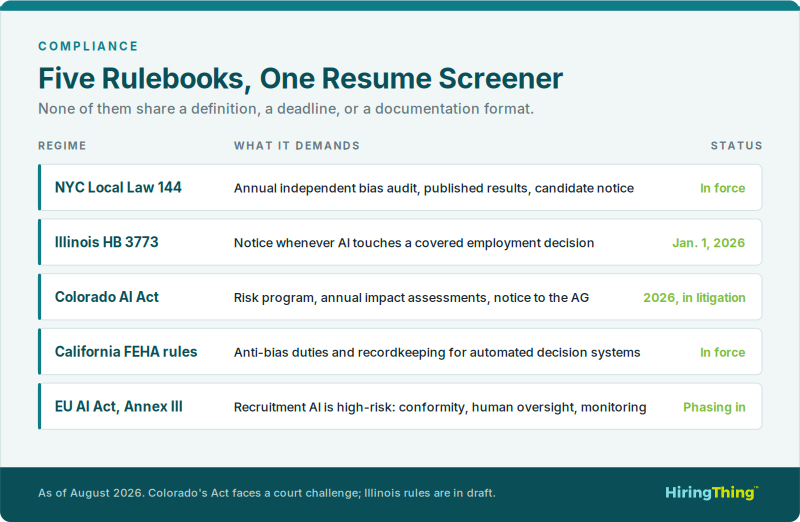
Five separate regimes now touch a single resume screening tool: New York City's bias audit law, Illinois HB 3773 (effective January 1, 2026), the Colorado AI Act (in force during 2026 and facing an active court challenge), California's amended FEHA regulations, and the EU AI Act, which classifies recruitment AI as high risk under Annex III. None of them share a definition, a deadline, or a documentation format.
Why You Should White Label Compliance-Ready Software
The real 2026 shift is from proving a tool is fair to proving you can document that it is fair. Deloitte found that only 35% of chief diversity officers say their boards involve them in conversations about AI's workforce impact, so the governance gap is wide and mostly unfilled. Licensing a module that already supports candidate notice, impact assessments, human review, and multi-year recordkeeping is dramatically cheaper than building that evidence trail yourself, in five formats, on someone else's deadline.
How to Establish a White Label HR Partnership
Here at HiringThing, we're the purveyors of a white label applicant tracking system and onboarding solution. White labeling is the backbone of our business, and we're passionate about helping other businesses become more competitive, and more successful, by helping them white label recruiting solutions. Because we're so passionate about our private labeling modality, we've created a guide, The Ultimate Guide to Establishing a Private Label Partnership, with everything you need to know about embarking on the white label journey. Check it out.
About HiringThing
HiringThing is a modern recruiting and employee onboarding platform as a service that creates seamless talent experiences. Our white label solutions and open API enable HR technology and service providers to offer hiring and onboarding to their clients. Approachable and adaptable, the HiringThing HR platform empowers anyone, anywhere to build their dream team.
.jpg)