


Anybody who has run hiring for an assisted living community knows the exact feeling of posting a caregiver opening on Monday and still staring at three unqualified applications on Friday afternoon. The good news is that most of what is broken in assisted living recruiting is a process problem, and process problems happen to be the thing technology is actually good at fixing.
Summary
- Assisted living competes for some of the same workers as hospitals, retail, and warehouses, and it usually loses on speed rather than on pay.
- An applicant tracking system solves the two problems that quietly kill caregiver hiring: slow response times and an application that takes twenty minutes on a phone.
- Employee referrals, a real career page, and text based communication move more candidates than another job board subscription will.
- Onboarding belongs in your recruiting plan because a hire who quits in week six was never really a hire.
The Math Is Not on Your Side, and That Is Fine
Let's start with the part nobody enjoys. The Bureau of Labor Statistics projects employment of home health and personal care aides to grow 17% between 2024 and 2034, with roughly 765,800 openings every single year over that decade. Most of those openings are not new jobs. They are replacements for people who left.
On the community side, the numbers are just as blunt. Industry surveys put roughly 63% of assisted living communities in an active staff shortage, with 87% reporting difficulty hiring. Argentum has projected the senior living industry will need to fill more than three million job openings between 2021 and 2040 just to keep pace with demand, and the federal HRSA long term services projections suggest demand for direct care workers is growing faster than supply, not slower.
I bring this up for one reason. You are not going to out-effort this problem. Working harder at a broken hiring process just gets you tired faster. What actually changes the outcome is removing friction, and that is a technology conversation.

Demand is climbing while the replacement burden stays enormous. Recruiting strategy in assisted living is less about finding more people and more about losing fewer of the ones who already applied.
Recruiting Strategies for Assisted Living Communities
Answer Applicants the Same Day
Here is the thing I wish more executive directors understood. A certified nursing assistant looking for work does not apply to your community and then waits politely. They applied to five or six employers in a single afternoon from the parking lot of their current job, and they took the first reasonable offer that came back. Not the best one. The first one.
That means your response time is your competitive advantage, and it costs nothing. An applicant tracking system handles this automatically:
- An acknowledgment goes out the moment somebody applies, not whenever a manager next opens the inbox.
- Qualified candidates advance through stages without anyone manually sorting them.
- Interview self scheduling lets the candidate pick a slot off your hiring manager's real calendar instead of playing phone tag for four days.
- Automated reminders cut the interview no-show rate, which in frontline hiring is the quiet killer.
If your average time from application to first contact is measured in days, you are not competing with the facility down the road. You already lost to them on Tuesday.
Make Applying Take Three Minutes on a Phone
Go apply to your own caregiver opening right now, on your phone, in the parking lot, with one thumb. Most people who try this exercise quit partway through their own application. If you have to create an account, upload a resume, and retype everything that was on the resume, you have built a filter that removes good candidates rather than bad ones.
For personal care assistant and CNA roles, the resume requirement is doing very little work for you. Replace it with a short set of screening questions that actually matter:
- Certification status and license number, if the role requires one.
- Availability for the specific shifts you are trying to cover, named plainly.
- Reliable transportation, which predicts attendance better than most interview questions.
- Willingness to complete a background check and any state required screening.
Modern hiring software lets you set those as knockout questions so unqualified applications sort themselves without a human reading them. Our team has written more about this approach for finding higher quality hourly employees, and the principle holds across every frontline industry.
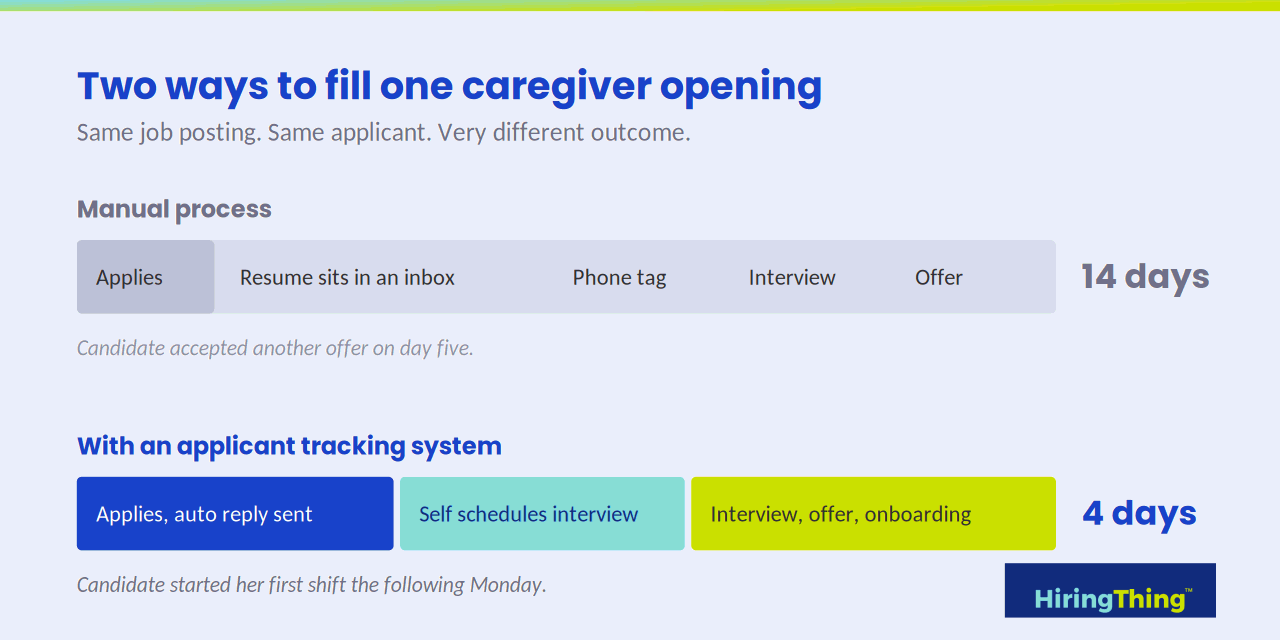
The difference is rarely the quality of the candidate. It is how many days your process spends waiting on a human being to check something.
Let the Software Handle the Repetitive Parts
Most assisted living communities are not staffed with full time recruiters. Hiring usually lands on a busy executive director, a business office manager, or a director of nursing who already has a full plate. That is precisely why automation matters more here than it does at a company with a dedicated talent team.
Where Automation Pays Off Fastest
- Job postings distributed to multiple job boards from one screen instead of five separate logins.
- AI assisted job descriptions, so you are not rewriting the same CNA posting for the fourth time this quarter.
- Resume screening that surfaces the applications worth reading first.
- Text messaging built into the platform, because a candidate who ignores email will answer a text in nine minutes.
- Interview scorecards, so three different managers evaluate the same things.
Compliance Belongs in the Same System
Add workflow management on top and the compliance side gets easier too. License and certification tracking, TB test documentation, background check status, and state specific training requirements can all live alongside the hiring record instead of in a filing cabinet and three spreadsheets. If you already run scheduling or payroll software, check the available integrations before you buy anything new.
Build a Career Page Worth Visiting
Candidates in senior care research employers. They ask former coworkers, they read reviews, and they look at your website before they apply. A career page that is a single line of text and a generic application form tells them nothing, so they fill in the blanks with their own assumptions, and those assumptions are usually unflattering.
- Use real photographs of your actual staff, not stock images of models in scrubs.
- Name the shift patterns. "Flexible scheduling" means nothing. "Three twelves, every other weekend" means everything.
- Post the pay range and describe your staffing ratios.
- Mention tuition assistance or a CNA to LPN pathway if you have one.
Communities that invest in training see the payoff in retention, a pattern we covered in our writeup on hiring and retaining high quality home health care workers.
Run Employee Referrals Like a Program
Your current caregivers know other caregivers. They know who is unhappy at the community across town, who just finished their certification, and who is dependable at four in the morning. Referred candidates are hired meaningfully faster than job board applicants, and they stay longer because somebody they trust told them the truth about the job before they took it.
The mistake is treating referrals as a poster in the break room. Make it a real program: a clear bonus, paid in two installments at 30 and 90 days, tracked inside your hiring system so nobody has to remember who sent whom. Then actually pay it on time, visibly, in front of other staff. One late referral bonus will shut the whole thing down for a year.
See what an ATS built for frontline hiring looks like
Post to every board, text candidates, and move new hires into onboarding without leaving one system.
Ways Assisted Living Communities Can Combat Turnover
Treat Onboarding as Part of Recruiting
This is the section most communities skip, and it is the one that costs the most. Nearly 60% of hourly workers leave within their first 90 days, and in senior care the first two weeks do almost all of the damage. A new aide who spends day one filling out paper forms in a back office, gets handed off to whoever is available for shadowing, and never hears from a supervisor again has already started looking.
Digital employee onboarding moves the paperwork to the night before the first shift, so day one can be spent meeting residents and meeting the team. Then build a simple check in cadence:
- Day 3. Confirm the schedule is what they were promised.
- Day 14. A five minute conversation with an actual supervisor, not a form.
- Day 30. Ask what surprised them, and fix whatever they name.
- Day 90. Talk about the next step, even if the next step is a year away.
It is not complicated and it is not expensive, and it will do more for your staffing numbers than any job board upgrade you can buy.
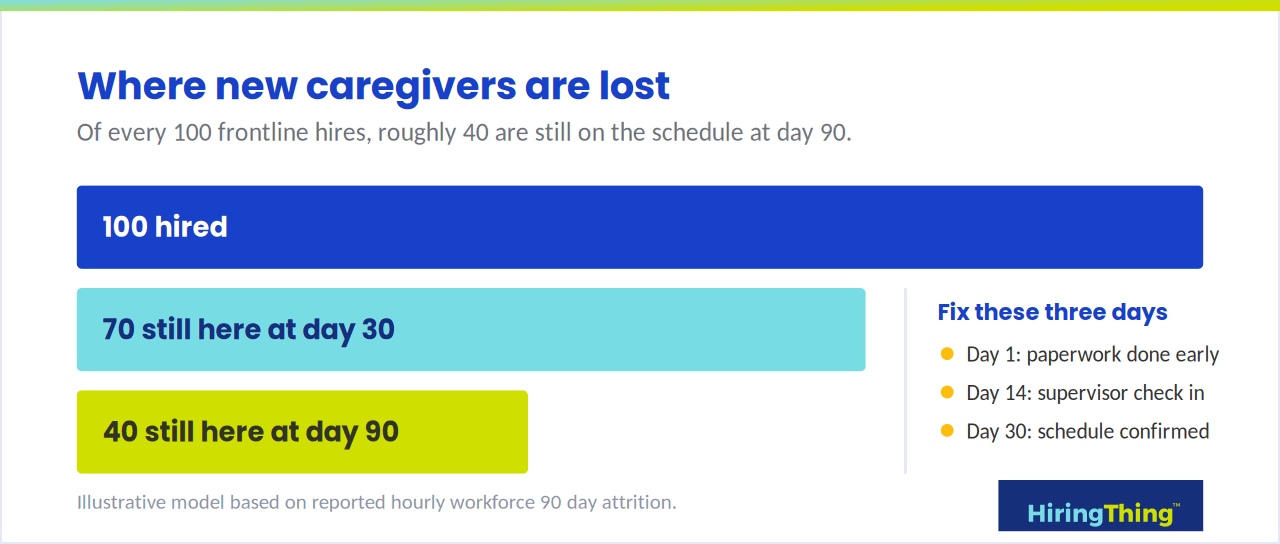
Every hire lost in the first 90 days sends you back to the beginning of the process. Retention math and recruiting math are the same math.
Track Two Numbers and Ignore the Rest
Recruiting dashboards can produce forty metrics, and thirty eight of them will not change a single decision you make.
For an assisted living community, watch these two:
- Time from application to first contact. Target the same day. This is the single number most correlated with whether you get the candidate.
- Source of hire. Know which board, referral, or campaign produces people who actually start, not people who merely apply, so you stop paying for the ones that do not.
Any decent applicant tracking system reports both without you building a spreadsheet. If yours cannot, that tells you something about your system.
There Is Plenty More You Can Do
None of this is exotic. Answer people faster, make applying easy, let software do the repetitive work, treat referrals seriously, and take onboarding as seriously as you take the interview. There are a dozen other things worth trying, from partnerships with local CNA training programs to open house hiring events to shift flexibility that actually accommodates a single parent's schedule, and most communities find their own version of what works.
But if you only have the energy to change one thing this quarter, change how fast you respond. It is free, it is immediate, and it is the difference between a caregiver who starts next Monday and one who is already working somewhere else.
About HiringThing
HiringThing is a modern recruiting and employee onboarding platform as a service that creates seamless talent experiences. Our white label solutions and open API enable HR technology and service providers to offer hiring and onboarding to their clients. Approachable and adaptable, the HiringThing HR platform empowers anyone, anywhere to build their dream team.


.jpg?width=45&name=1621426681866%20(1).jpg)